
Appearance
6. Client billing under GST
Back to the case study · Previous: 5. Payroll, payslips and statutory files · Next: 7. Overseas hiring in the CRM
6.1 The bill comes from the duties
Open a contract and choose Bill. The bill is built from the duty grid, not typed.
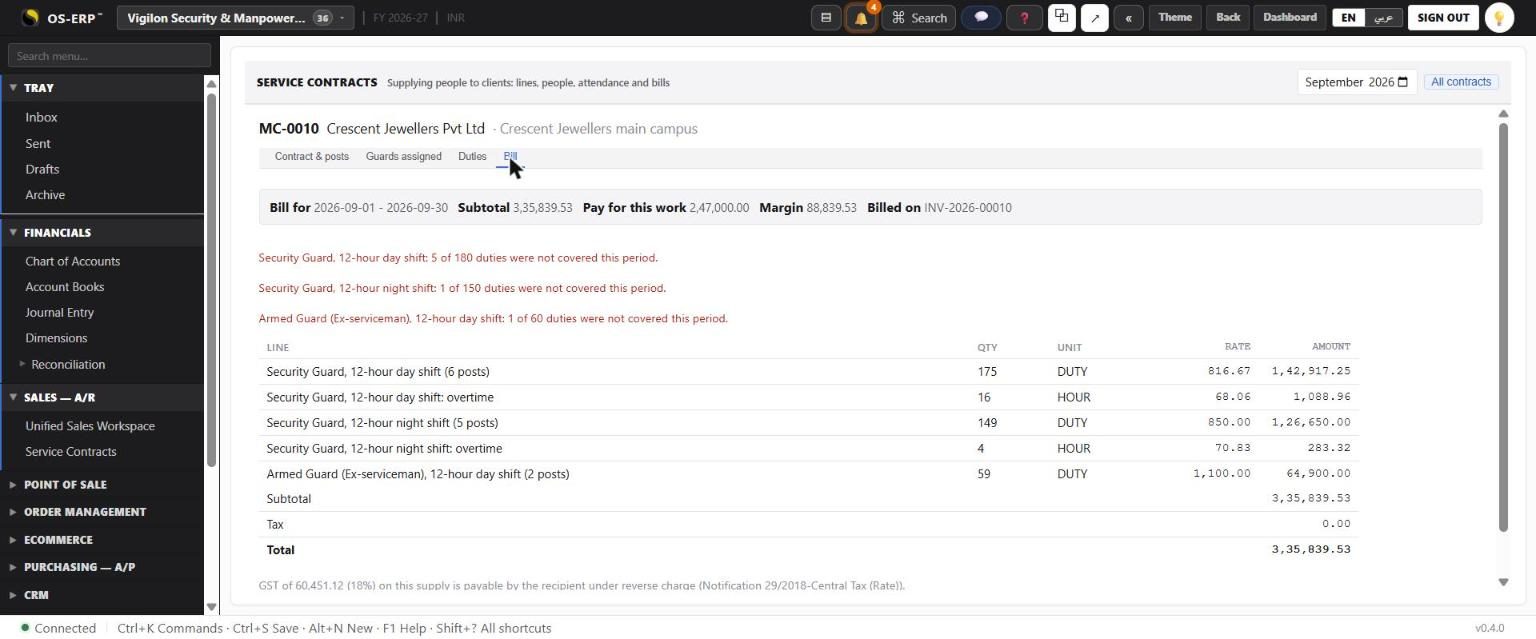
For Crescent Jewellers, September:
| Line | Duties / hours | Rate | Amount |
|---|---|---|---|
| Security guard, 12-hour day shift (6 posts) | 175 duties | 816.67 | 1,42,917.25 |
| Day shift overtime | 16 hours | 68.06 | 1,088.96 |
| Security guard, 12-hour night shift (5 posts) | 149 duties | 850.00 | 1,26,650.00 |
| Night shift overtime | 4 hours | 70.83 | 283.32 |
| Armed guard (ex-serviceman), 12-hour day shift (2 posts) | 59 duties | 1,100.00 | 64,900.00 |
| Subtotal | 3,35,839.53 | ||
| GST | 0.00 | ||
| Total | 3,35,839.53 |
- A duty is the monthly rate divided by the days in the month: 24,500 / 30 = 816.67.
- Uncovered duties are named above the lines: 5 of 180 day duties, 1 of 150 night duties and 1 of 60 armed duties were not covered. The client is billed for what was guarded, and both sides can see why the bill is below the contract value.
- Wages for these duties (2,47,000) and the margin (88,839.53) show beside the subtotal, for Vigilon's eyes only.
6.2 GST: reverse charge or forward charge
Crescent Jewellers is a company and Vigilon a proprietor, so the GST of 60,451.12 (18%) is payable by Crescent Jewellers under reverse charge (Notification 29/2018-Central Tax (Rate)). The bill charges no GST and carries that sentence on every line, so it reaches the invoice whatever happens to the remarks.
| Client | GST on the bill | Who pays the GST |
|---|---|---|
| A company (42 of 50 sites) | None | The client, under reverse charge |
| A trust, society or residents' association (8 sites) | 18% | Vigilon, collected on the bill |
The contract's GST field decides this once; the bill follows it every month.
6.3 Raising the bill
Raise bill creates an ordinary sales document at the start of the company's sales flow, so any approval a company has set applies to a bill as to any sale. Open in Sales opens it; advancing it to Invoice posts it to the ledger through the GL mappings. The contract list shows the invoice number against the month (chapter 4).
September: 50 bills, INR 1,50,13,142 before GST (1,54,50,101 with GST from the forward-charge clients). About three in four had been paid by the middle of October; the rest show in the customer's dues and the receivables ageing, and the CRM's Customer 360 shows each client's open invoices.
6.4 Where the income goes
Each line of a bill is raised under a service item: the contract line's own, else the company's default for contract lines, Security guarding services. The item puts its services code (SAC 998525) on the invoice line, which the GST returns' summary by HSN/SAC reads. The posting rule for service invoices books revenue line by line, so each item's income goes to its own account: guarding to Income from Security Services, recruitment to Income from Recruitment Services (chapter 7). The receivable and the tax lines are booked exactly as on any other invoice.
The tax on a bill follows the contract's GST setting, because reverse charge is decided per client; the item's own rate is the default for a new contract.
September's bills were raised before Vigilon's billing items were set up, so their income sits in Sales; bills from October are booked to Income from Security Services. A reclassification journal moves earlier income across when a company wants one account for the year, as Vigilon did for recruitment (chapter 7).
6.5 The contract labour paperwork
The client is the principal employer under contract labour law and must see that Vigilon paid its guards. Vigilon sends the register of wages and the muster roll from chapter 5 with each bill, and the client's own registration number is on the contract. The registers cover the whole run; Vigilon cuts them to the site in a spreadsheet, because a per-site register is not built yet.