
Appearance
1. The business and setting up manufacturing
Back to the case study · Next: 2. Items and recipes
1.1 How a central kitchen works
A cloud kitchen brand does not cook everything in every outlet. The slow, skilled and risky work is done once, in one central kitchen, and the outlets finish the dish in minutes when an order comes in:
| Done in the central kitchen (the night shift) | Done in the outlet (to order) |
|---|---|
| Deboning chicken, peeling and chopping onions | Grilling the marinated tikka |
| Slow-cooking the onion-tomato base for 90 minutes | Finishing a gravy with the protein |
| Cooking makhani gravy and biryani masala | Cooking the biryani rice with the base |
| Marinating chicken and paneer for 12 hours | Rolling and cooking rotis from the dough balls |
| Blast-chilling everything to 5 C, filling, sealing, labelling | Packing for the delivery rider |
So the central kitchen is a factory: it buys raw food, turns it into semi-finished food in steps, packs it, checks it, and ships it chilled to the outlets every morning. Every pack has a lot number and a use-by date. That is exactly what OSERP's manufacturing module is for.
1.2 Spice Republic Kitchens Pvt Ltd
| Business | North Indian delivery brand: tikkas, curries, biryani and rotis |
| Central kitchen | Peenya, Bengaluru: one night shift from 10 pm, dispatch from 6 am |
| Outlets | 100 delivery kitchens across Bengaluru, Mysuru and nearby towns |
| People | 500 |
| Suppliers | Poultry farm, vegetable market trader, dairy, spice and grocery wholesaler, food container maker |
| Planner | Kavya Menon, the production planner, who runs OSERP day to day |
The 500 people, by department:
| Department | People | Roles |
|---|---|---|
| Central kitchen | 113 | Executive chef, production manager, planner, 4 shift leads, 30 commis, 14 butchers, 20 cooks, 10 on marination, 14 packers, 8 on the dough line, 10 stewards |
| Quality | 6 | 4 food safety officers, 2 lab technicians |
| Stores | 10 | Stores manager and 9 store keepers |
| Logistics | 25 | Logistics manager, 18 reefer van drivers, 6 loaders |
| Outlets | 336 | 100 outlet managers, 100 line cooks, 136 kitchen helpers |
| Head office | 10 | CEO, finance controller, accountants, HR, purchasing, 2 area managers |
Every one of them is in People & Payroll, with their department, designation and employment type. Production does not need them one by one: what it needs is how many hours each station has and what an hour costs, which is the next step.
1.3 Start from the Central kitchen pack
Manufacturing > Industry setup offers starter packs for common trades. Kavya chose Central kitchen and cloud kitchens:
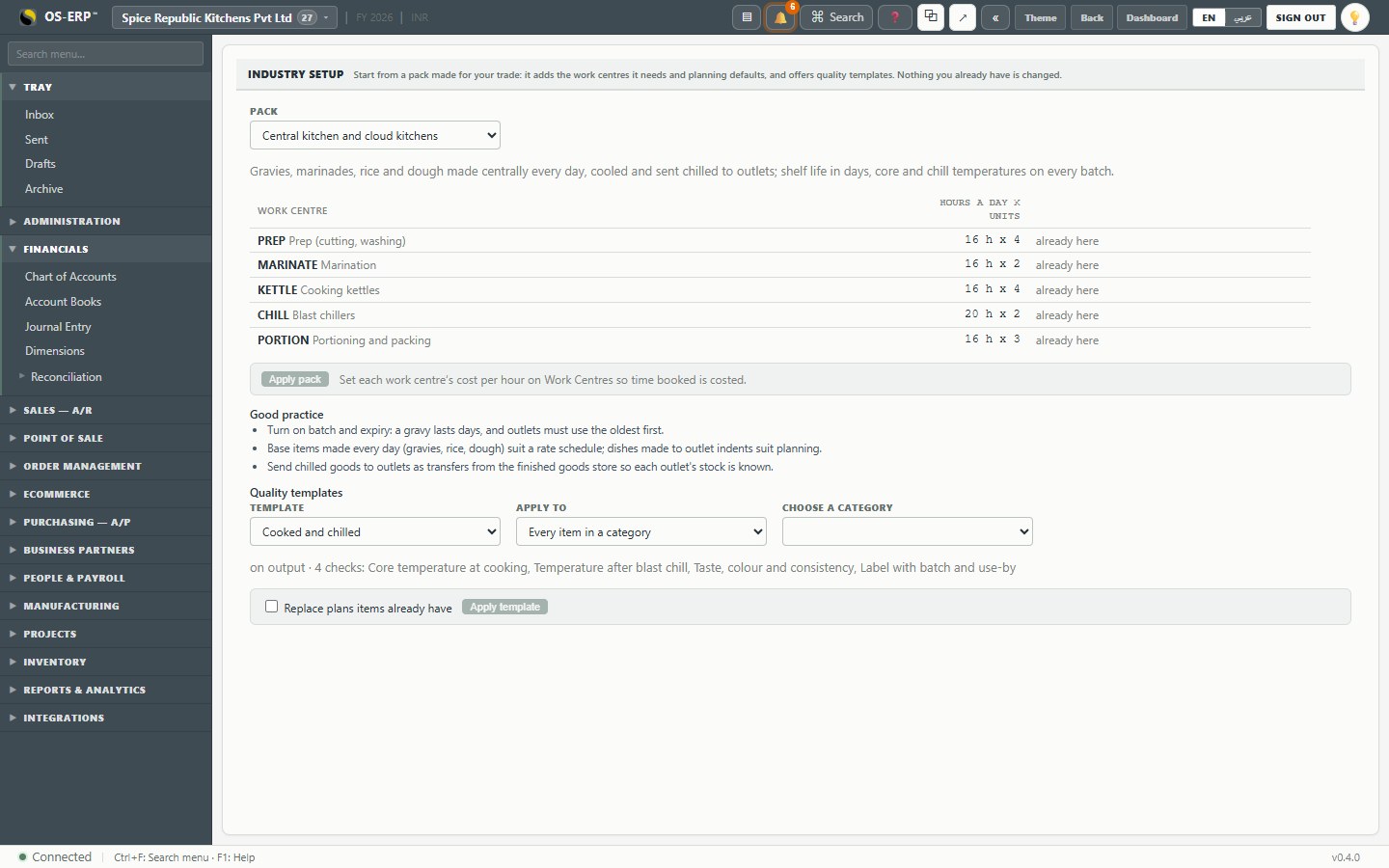
The pack adds, only where missing:
- Five work centres, the stations of a commissary kitchen, each with its hours, parallel units and efficiency.
- Planning defaults for a business that cooks every day: a 14-day horizon, a nightly planning run at 2 am, and forecasts spread by day (a kitchen does not cook a month's demand on the 1st).
- Two quality templates: Cooked and chilled for what the kitchen makes, and Meat, dairy and produce (incoming) for what it receives.
- Good practice notes, shown at the bottom.
Nothing that already exists is changed, so a pack can be applied to a company that is already running.
1.4 Work centres and what an hour costs
Manufacturing > Work Centres shows the stations. Kavya added a sixth for the dough line, and set what each hour costs: the wages of the crew at that station plus gas and power.
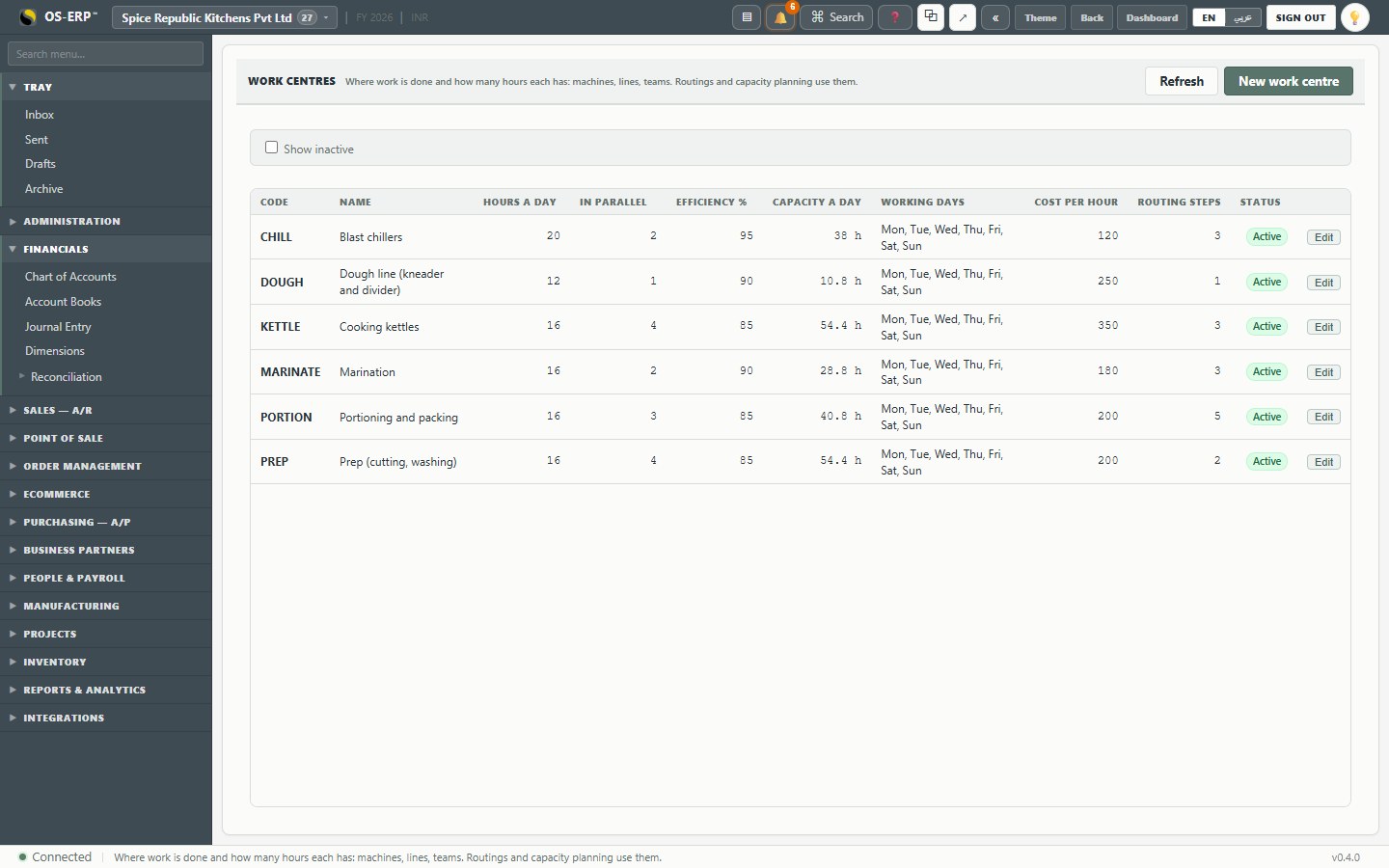
| Code | Station | Hours a day x stations | Efficiency | Capacity a day | Cost per hour (INR) |
|---|---|---|---|---|---|
| PREP | Prep (cutting, washing, deboning) | 16 h x 4 | 85% | 54.4 h | 200 |
| MARINATE | Marination | 16 h x 2 | 90% | 28.8 h | 180 |
| KETTLE | Cooking kettles | 16 h x 4 | 85% | 54.4 h | 350 |
| CHILL | Blast chillers | 20 h x 2 | 95% | 38 h | 120 |
| PORTION | Portioning and packing | 16 h x 3 | 85% | 40.8 h | 200 |
| DOUGH | Dough line (kneader and divider) | 12 h x 1 | 90% | 10.8 h | 250 |
Capacity a day = hours x stations x efficiency. It is what planning and the scheduling board fill. Cost per hour is what turns booked time into cost: when a cook books 90 minutes on a kettle, INR 525 goes onto that batch.
Why the hourly cost matters
Without it, a pack of makhani gravy costs only its tomatoes, butter and cream, and the kitchen looks more profitable than it is. With it, labour, gas and power are inside every pack's cost, and the gap between planned and actual time becomes visible.
1.5 Stores and the 100 outlets
Inventory > Warehouses holds every place stock can be:
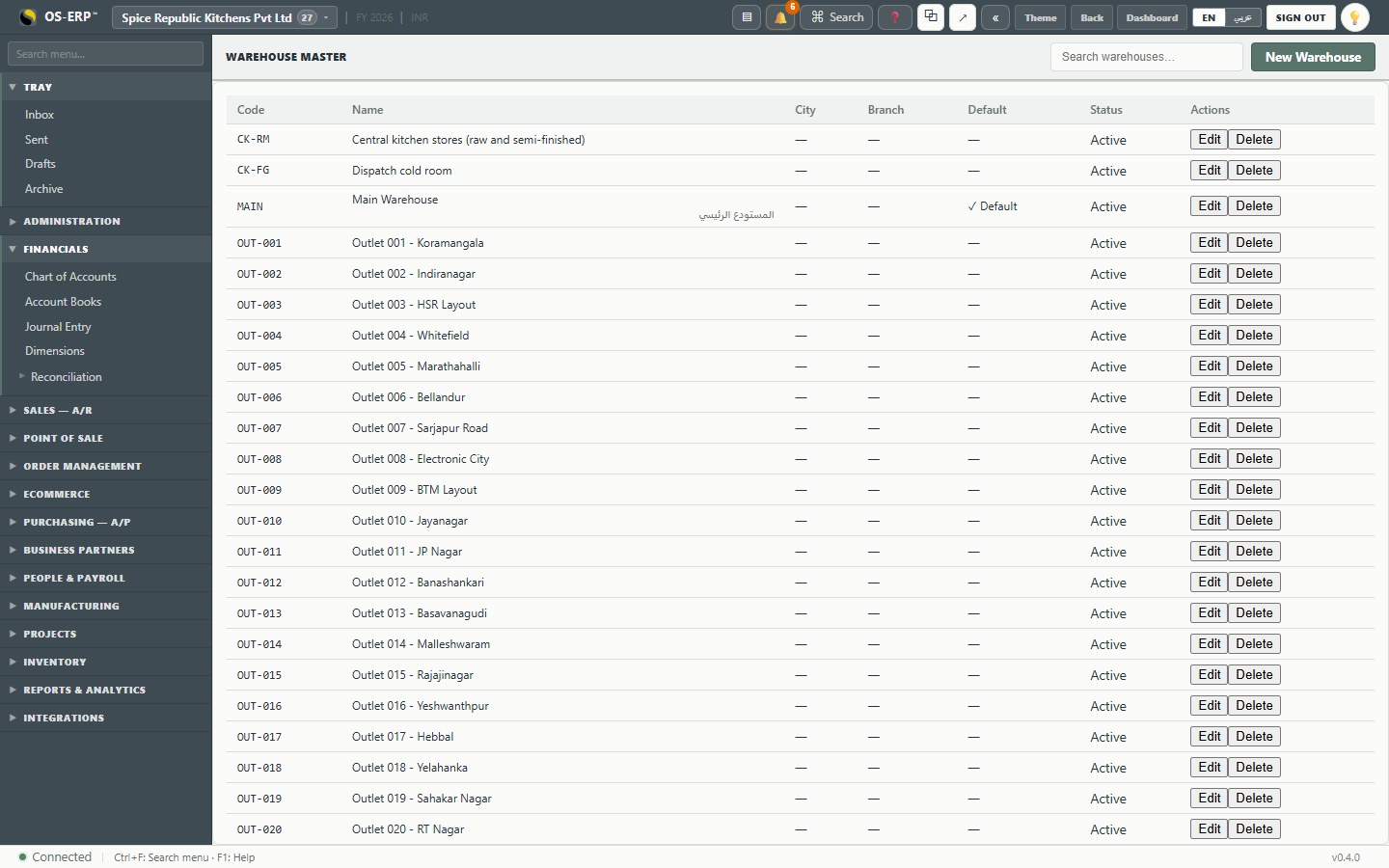
| Store | What it holds |
|---|---|
| CK-RM Central kitchen stores | Raw food, packaging, and semi-finished food (bases, bulk gravy, marinade, boneless chicken) |
| CK-FG Dispatch cold room | Finished packs ready for the vans |
| QC-HOLD Quality hold | Anything waiting for a quality decision. Made on first use; nothing in it can be issued, sold or sent |
| OUT-001 to OUT-100 | One store per outlet |
Making every outlet a store is what makes the rest possible: each outlet's stock is known, the morning dispatch is a stock transfer, and a lot can be traced to the outlets that received it.
1.6 The cockpit
Manufacturing > Cockpit is Kavya's first screen every morning:
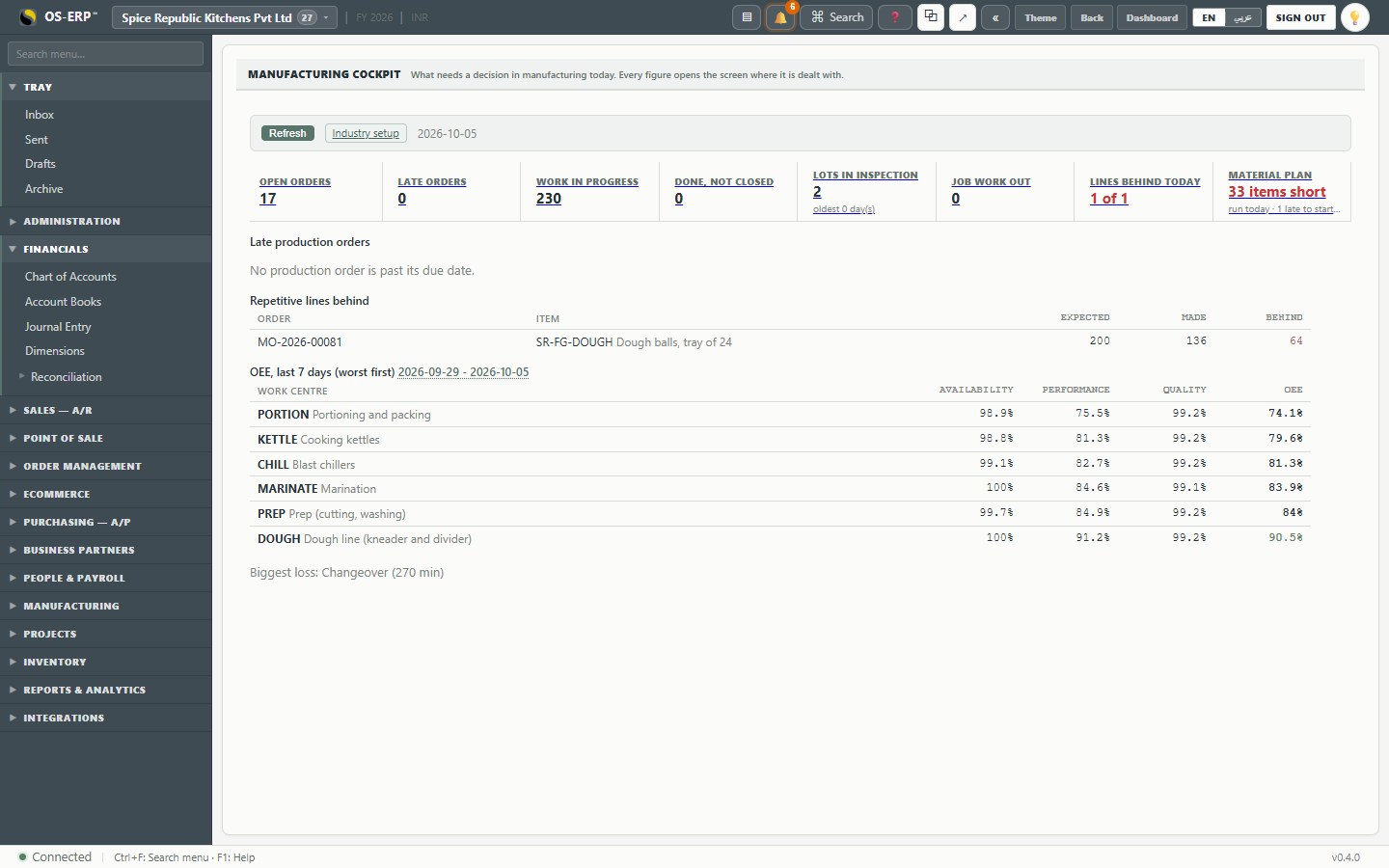
Every figure opens the screen where it is dealt with:
| Figure | What it tells her |
|---|---|
| Open orders | Production orders not yet closed |
| Late orders | Orders past their due date |
| Work in progress | Value of food issued to production and not yet turned into packs |
| Done, not closed | Finished orders waiting for their cost to be settled |
| Lots in inspection | Packs and deliveries waiting in QC-HOLD |
| Lines behind today | Rate lines (the dough line) behind their daily rate |
| Material plan | When planning last ran, and how many items are short |
Below them: late orders, repetitive lines behind, and OEE for the last seven days, worst station first.