
Appearance
7. Changes, risks and keeping the client informed
Back to the case study · Previous: 6. Delivering the build · Next: 8. Invoicing, revenue, close-out and lessons
7.1 Change orders (Changes tab)
On a fixed price, the contract value moves only through a change order. In July the client asked for two more things.
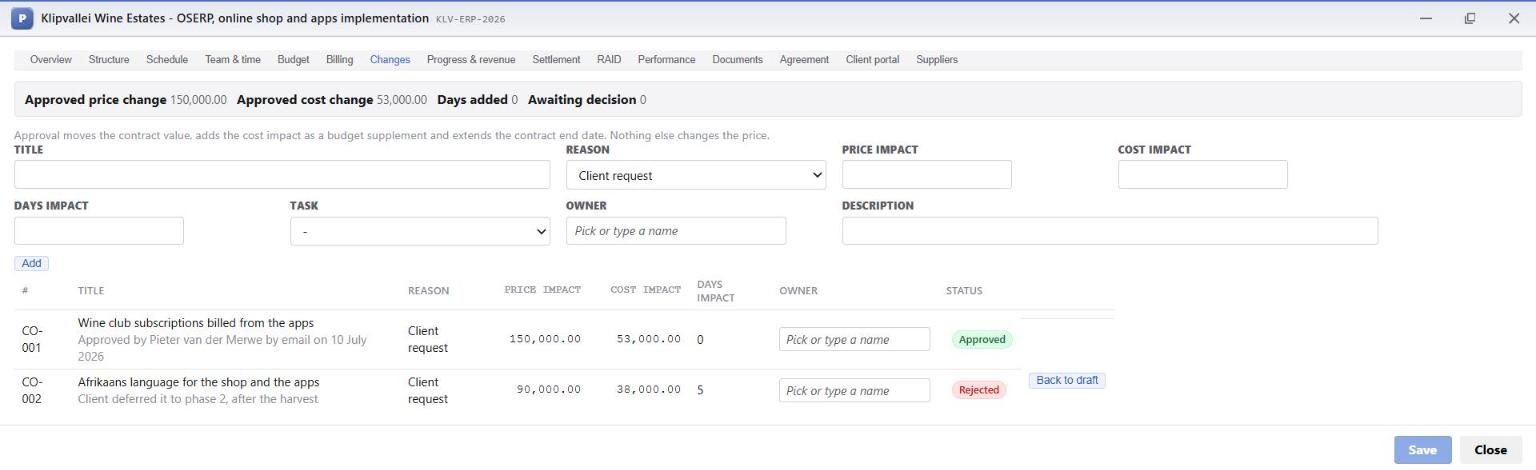
CO-001: wine club subscriptions in the apps (approved)
Pieter wanted members to subscribe to a monthly or quarterly case from the app, with the card charged automatically. Sanjay and Ananya estimated 40 and 20 hours. Meera priced it and entered:
| Field | Entered |
|---|---|
| Title | Wine club subscriptions billed from the apps |
| Reason | Client request |
| Price impact | 1,50,000 |
| Cost impact | 53,000 (40 h x 950 + 20 h x 750) |
| Days impact | 0 (done alongside the build) |
| Task | 1.4.2 Customization: age verification and wine club |
| Description | Members choose a quarterly or monthly case in the apps; the card is charged through PayFast on the renewal date; the order reaches OSERP as an ordinary online order |
Submit, then once the client agreed in writing, Approve with the note Approved by Pieter van der Merwe by email on 10 July 2026. Approval does three things at once:
- The contract value goes from 17,00,000 to 18,50,000.
- The cost impact becomes a budget supplement (v2) on step 1.4.2.
- The contract end date moves by the days impact. Here it was 0.
Meera then added a billing line for it on the Billing tab: Change order CO-001: wine club subscriptions, 1,50,000, Milestone, tax 0, due 25 September.
CO-002: Afrikaans language (rejected)
An Afrikaans version of the shop, the apps, emails and messages: 90,000, 38,000 of cost, 5 days. The client deferred it until after the harvest. Reject needs a reason: Client deferred it to phase 2, after the harvest. A rejected change stays on the list, so the conversation is on record when phase 2 is discussed.
Price the change before doing it
CO-001 earned 97,000 of margin (1,50,000 less 53,000). That is more than twice the 41,700 of extra hours the project absorbed elsewhere. It earned that because it was priced and approved before anybody built it. The same work done as a favour, or "while we are in there", would have been 53,000 more cost against an unchanged price.
7.2 The RAID log as the project ran (RAID tab)
Two risks became issues:
| Kind | Entry | Score | What happened |
|---|---|---|---|
| Issue | First iOS submission rejected: the age check came after browsing | 20 Critical | Age gate moved to first launch; resubmitted and approved in three days. 10 extra UI/UX hours absorbed. |
| Issue | The Courier Guy moved to a new API version in the middle of the build | 15 High | Connector rebuilt on the new version. 24 extra hours absorbed, not billable to the client. |
The others were closed as the project passed them: load-shedding (UPS and the offline-capable till in place), excise rules (signed off by the client's customs agent), app store accounts (opened in the client's name on time), Pastel exports (received 24 July), POPIA wording (approved 14 August).
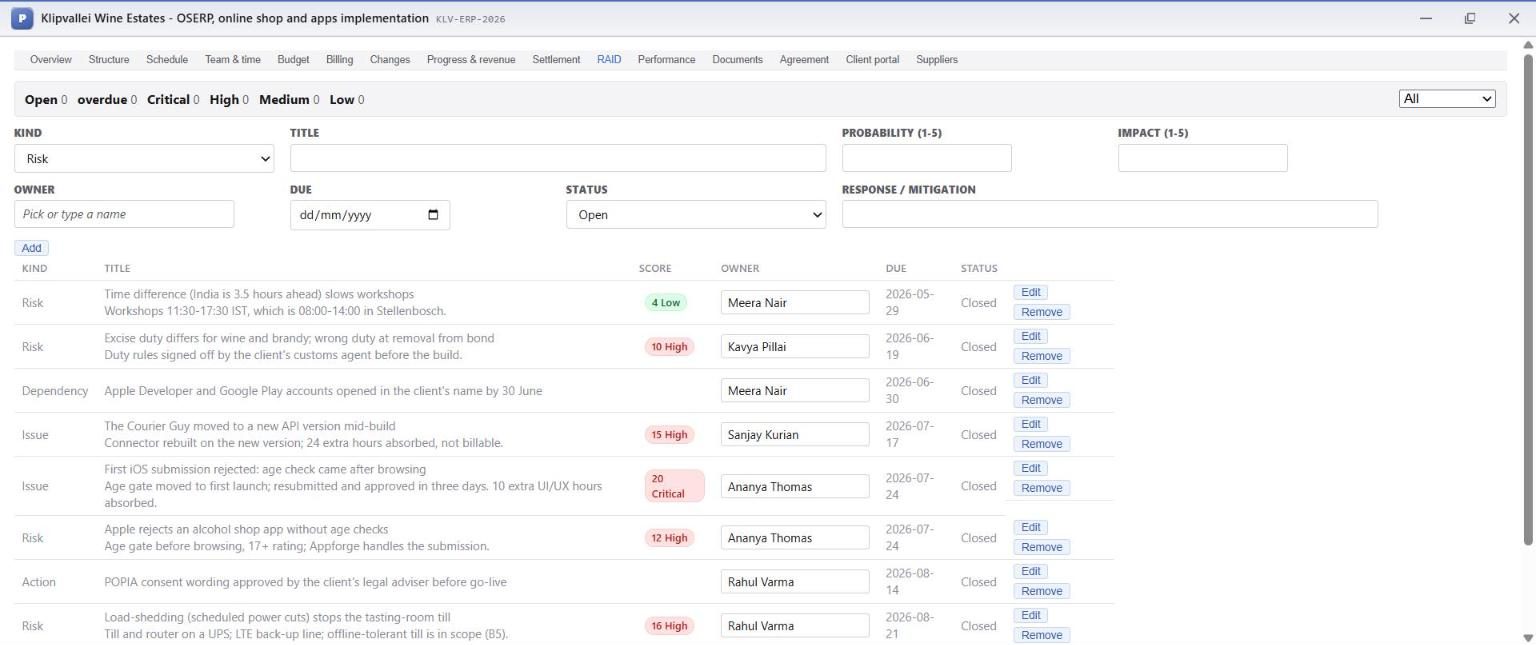
The filter at the top shows Open, Overdue, and counts by severity. My work on the Projects list shows each person the RAID entries that fall to them, including those they inherit as a phase owner.
7.3 Documents and sign-offs (Documents tab)
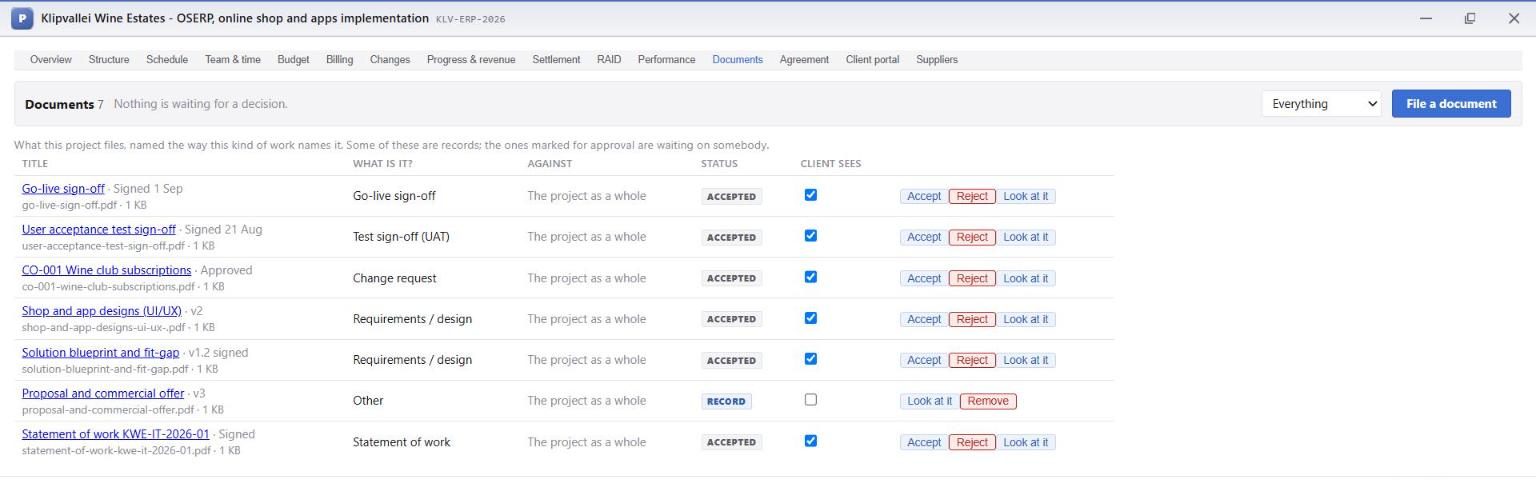
As each sign-off happened, the signed document was filed against the project with Client sees ticked, and then Accepted:
| Document | Kind | When |
|---|---|---|
| Statement of work KWE-IT-2026-01 | Statement of work | Signed 27 April |
| Solution blueprint and fit-gap | Requirements / design | Signed 5 June |
| Shop and app designs (UI/UX) | Requirements / design | v2 |
| CO-001 Wine club subscriptions | Change request | Approved 10 July |
| User acceptance test sign-off | Test sign-off (UAT) | Signed 21 August |
| Go-live sign-off | Go-live sign-off | Signed 1 September |
| Proposal and commercial offer | Other (internal, not shown to the client) |
7.4 Keeping the client informed (Client portal tab)
The client follows the project on Nimbus's own website, through the client portal.
- Invite (Client portal tab): Thandi Nkosi, Klipvallei's finance manager, with the rights to download documents, approve, and see invoices so she can pay them. She receives an email, sets her own password and signs in at Client login.
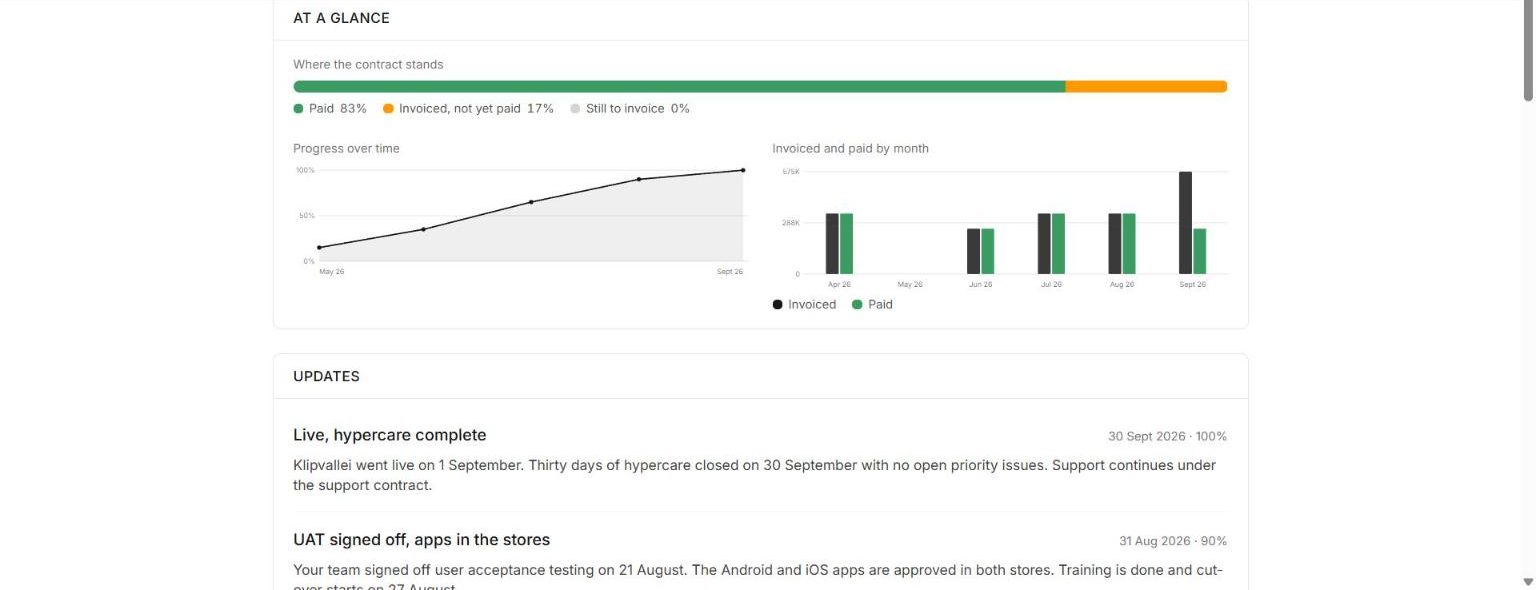
- Updates for the client: at each month end Meera wrote a short update with a headline, a paragraph and the progress percentage the client should see, then pressed Publish:
| As of | Headline | Progress |
|---|---|---|
| 31 May | Workshops done, blueprint under way | 15% |
| 30 June | Blueprint signed off, build started | 35% |
| 31 July | Build complete | 65% |
| 31 August | UAT signed off, apps in the stores | 90% |
| 30 September | Live, hypercare complete | 100% |
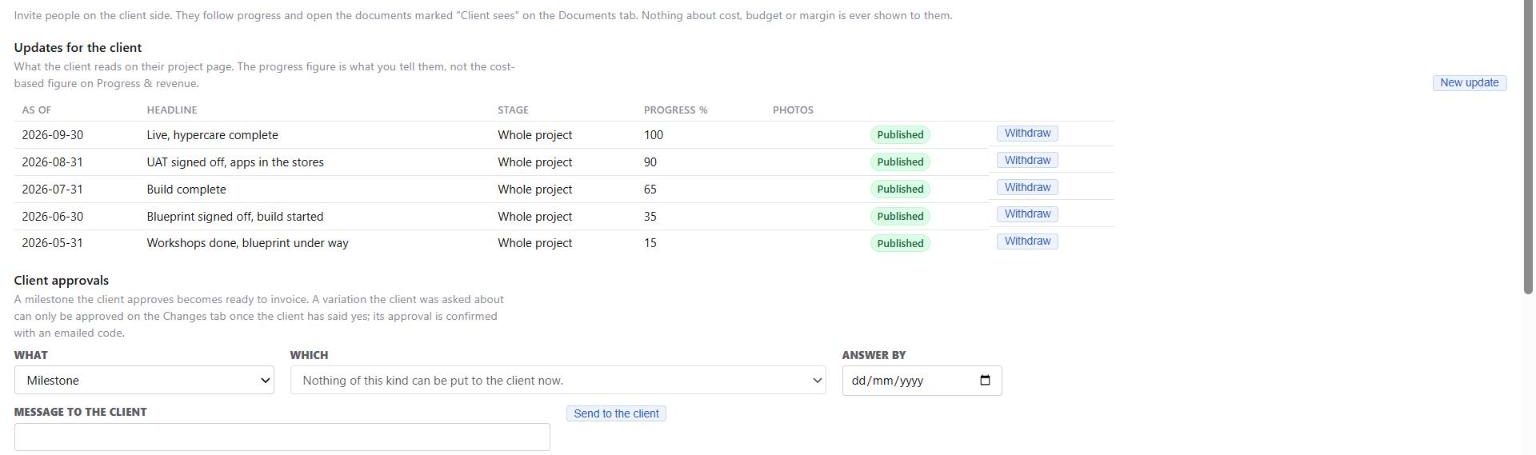
The percentage in an update is what you tell the client. The cost-based figure on the Progress & revenue tab stays internal.
What Thandi sees when she signs in: the status, the dates, the project manager, progress, and tabs for updates, the schedule, agreements, her Account and documents.
What this chapter meant for the money
The change order turned a client request into 97,000 of margin. The RAID log recorded each problem with its owner and the hours it cost. The portal saved the weekly "where are we?" calls: the client could see progress, documents and invoices for herself.