
Appearance
7. Variations: getting paid for change
Back to the case study · Previous: 6. Subcontractor claims
On almost every residential project the client asks for more once they see the house taking shape. If the extra work starts on a verbal "yes" on site, two things usually happen: the company carries the cost, and the client disputes the price when the invoice arrives. On this project the change was priced, approved online and paid for, and it turned a joinery overrun into a profit.
7.1 The request
On 2 June Sara wrote in the portal's Messages: We would also like quartz in the kitchen instead of granite, and the basement as a small cinema. Can you price it? (The home cinema was already listed as an Optional item in the agreement, chapter 3.)
The joinery subcontractor priced the extra work at AED 98,000. The company priced it to the family at AED 165,000.
7.2 Record it as a change order (Changes tab)
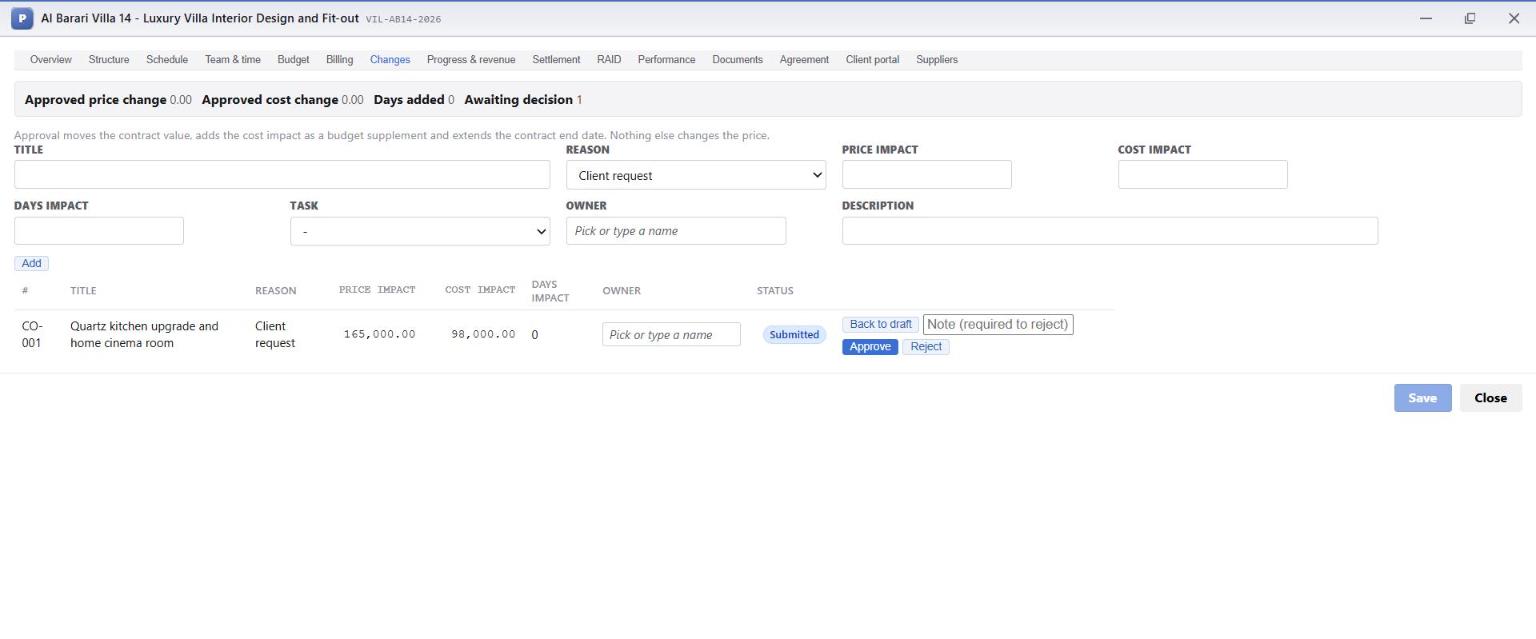
On the Changes tab Priya added the variation:
| Field | Entered | What it does |
|---|---|---|
| Title | Quartz kitchen upgrade and home cinema room | Shown to the client |
| Reason | Client request | Other reasons include design development, site condition, error and omission |
| Price impact | 165,000 | What the client pays. On approval it is added to the contract value |
| Cost impact | 98,000 | What it costs the company. On approval it is added to the budget as a supplement |
| Days impact | 0 | Working days added to the programme, if any. On approval the end date moves |
| Task | Kitchen, wardrobes and wall panelling | The task the budget supplement goes to |
| Description | Quartz worktops and splashback in place of the specified granite, and fit-out of the basement room as a home cinema ... | Shown to the client |
She saved it and chose Submit. The change order is now Submitted, waiting for a decision. Nothing in the contract or budget has moved yet.
The rule that protects the margin
A variation the client was asked about can only be approved on the Changes tab once the client has said yes. The company cannot approve a price change on the client's behalf, and the client's yes is confirmed with an emailed code.
7.3 Put it to the client
On the Client portal tab, under Client approvals, Priya chose What: Variation, picked CO-001, and wrote: Please review and approve the quartz kitchen upgrade and the home cinema before we order. The family received an email.
7.4 The client approves with an emailed code
On the family's project page, Needs your answer showed the variation with its price, AED 165,000, and the full description:
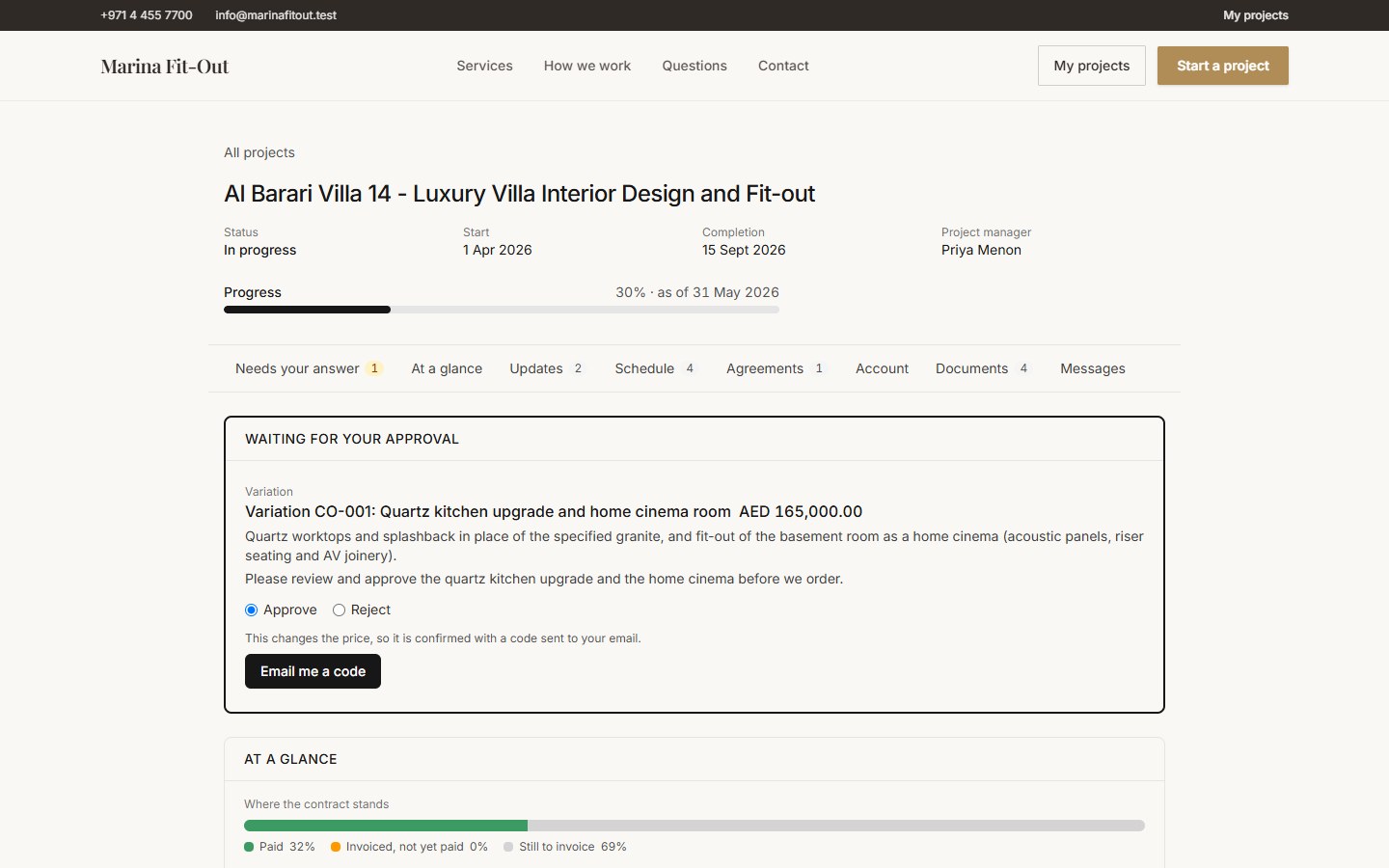
Because a variation changes the price, approving it works like accepting the agreement: Email me a code, then the code and her full name, then Approve.
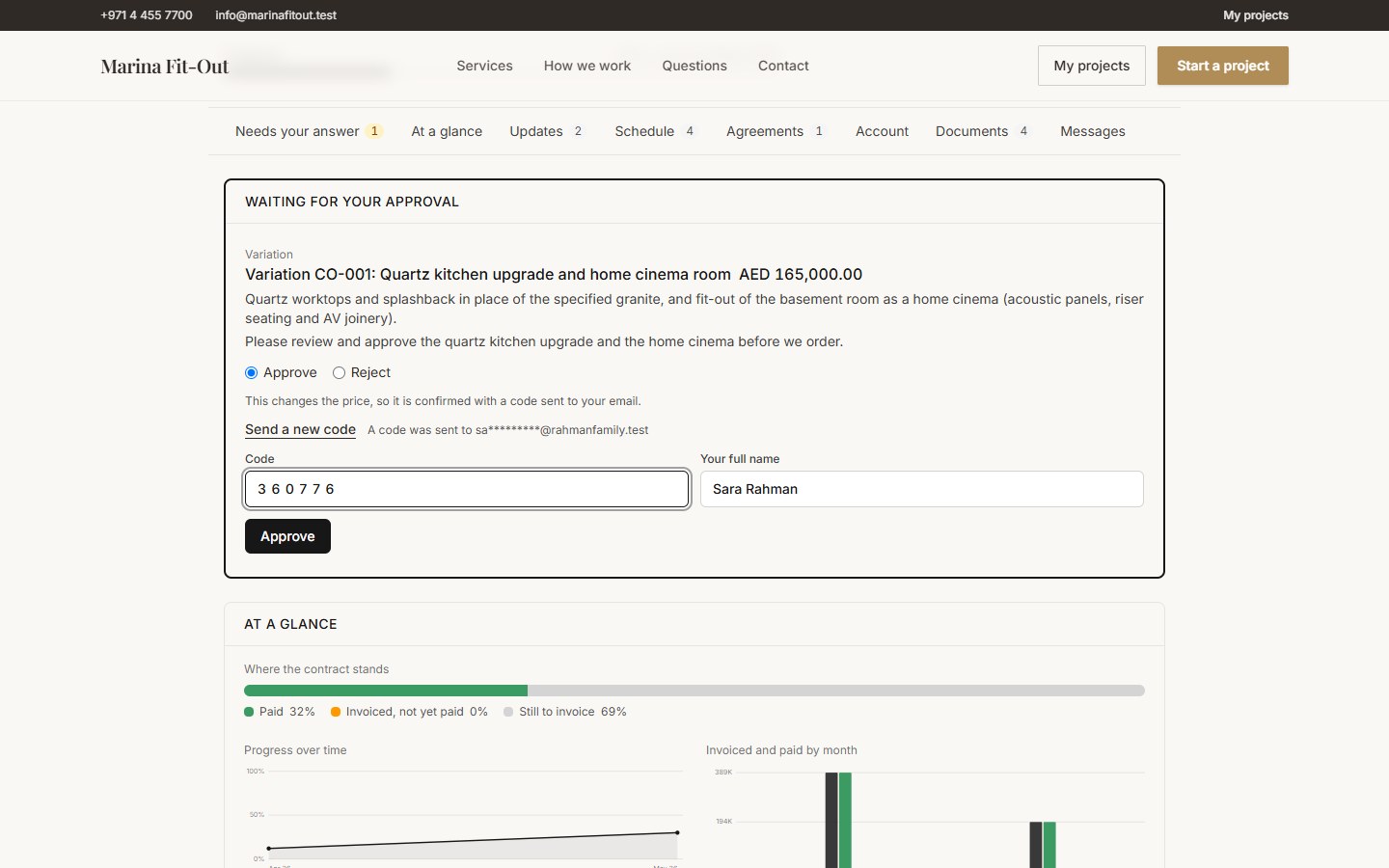
Sara approved it on 8 June. OSERP recorded the evidence: who approved, when, the address the code was sent to, and that it was confirmed with a one-time code.
7.5 Approve it in OSERP
With the client's yes recorded, Priya approved CO-001 on the Changes tab. In one step, OSERP:
- raised the contract value from 1,850,000 to 2,015,000;
- added a budget supplement of 98,000 to the joinery task (the
v2next to the originalv1on the Budget tab, chapter 4), keeping the original tender budget intact; - left the end date unchanged (0 days).
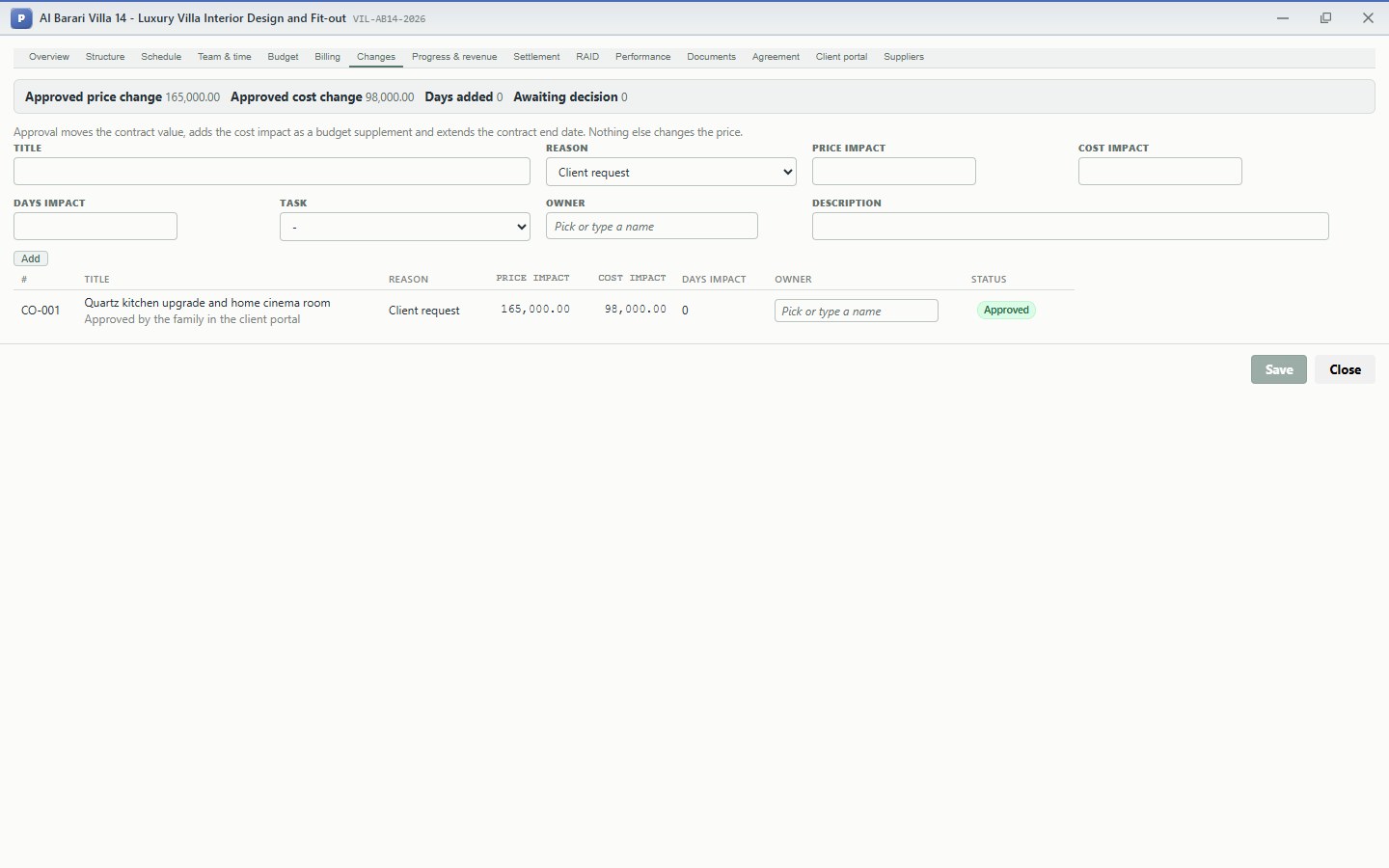
The summary along the top keeps the totals: Approved price change 165,000, Approved cost change 98,000, Days added 0, Awaiting decision 0.
The company then ordered the extra joinery from Gulf Joinery as its own work order (98,000), which went straight onto the budget as a commitment against the supplement, and added a billing line Approved variation: Quartz kitchen upgrade and home cinema room of 165,000 with 5% retention. It was invoiced on 15 August and paid on 31 August.
7.6 What the variation did to the profit
| AED | |
|---|---|
| Price agreed with the family | 165,000 |
| Cost from the joinery subcontractor | 98,000 |
| Margin on the variation | 67,000 (40.6%) |
| Overrun on the original subcontract orders (chapter 4) | -21,820 |
| Net gain against the planned profit | +45,180 |
The joinery overrun the budget flagged in April was absorbed more than twice over, by work the family asked for, priced before it started and approved in writing.
Why variations are usually lost, and how this one was not
| How variations are usually lost | What OSERP did instead |
|---|---|
| Agreed verbally on site; the price is argued months later | Priced before work, approved by the client online with a code, the evidence recorded |
| The extra cost goes to the job and nobody tracks it separately | The cost impact became a budget supplement on the right task, and the order was committed against it |
| Forgotten at final account | It became its own billing line the moment it was approved |
| Optional items quoted at tender are re-quoted from scratch | The cinema was already in the agreement as an Optional item, so the family knew it was coming |
What this chapter means for the business
- A change is never started without a price the client has accepted in writing.
- The contract value, the budget and the billing plan move together when a variation is approved, so nothing is forgotten at final account.
- Variations are where interior projects make or lose their margin. This one was worth AED 67,000, more than the whole overrun.