
Appearance
5. Budget, timesheets and purchases
Back to the case study · Previous: 4. The agreement and the billing plan · Next: 6. Delivering the build
An implementation project's cost is mostly people's time, plus a few purchases. This chapter shows how both reach the project in OSERP, and how the budget tells the project manager, step by step, where the money is going.
5.1 The cost budget (Budget tab)
For each step, Add budget with the amount and a note. Meera entered the estimate from chapter 1, labour and purchases together, on the step that spends it:
| Step | Budget | Note |
|---|---|---|
| Process workshops | 53,600 | Labour |
| UX research, brand kit and app designs | 52,500 | Labour |
| Customization: South African VAT and VAT201 | 40,700 | Labour |
| Android and iOS apps | 1,05,000 | Labour 30,000 + Appforge subcontract 75,000 |
| WhatsApp and SMS notifications | 31,000 | Labour 19,000 + messaging credits 12,000 |
| System and security testing | 54,500 | Labour 9,500 + security test 45,000 |
| Cut-over | 1,75,400 | Labour 15,400 + go-live travel 1,60,000 |
| Project management and governance | 1,87,000 | Labour |
| ... 15 more steps | ||
| Total | 12,10,000 |
The header reads Budget, Cost, Committed (purchase orders placed but not yet billed) and Available = budget - cost - committed. Each phase adds up the steps below it, and a budget set on a phase controls everything under it.
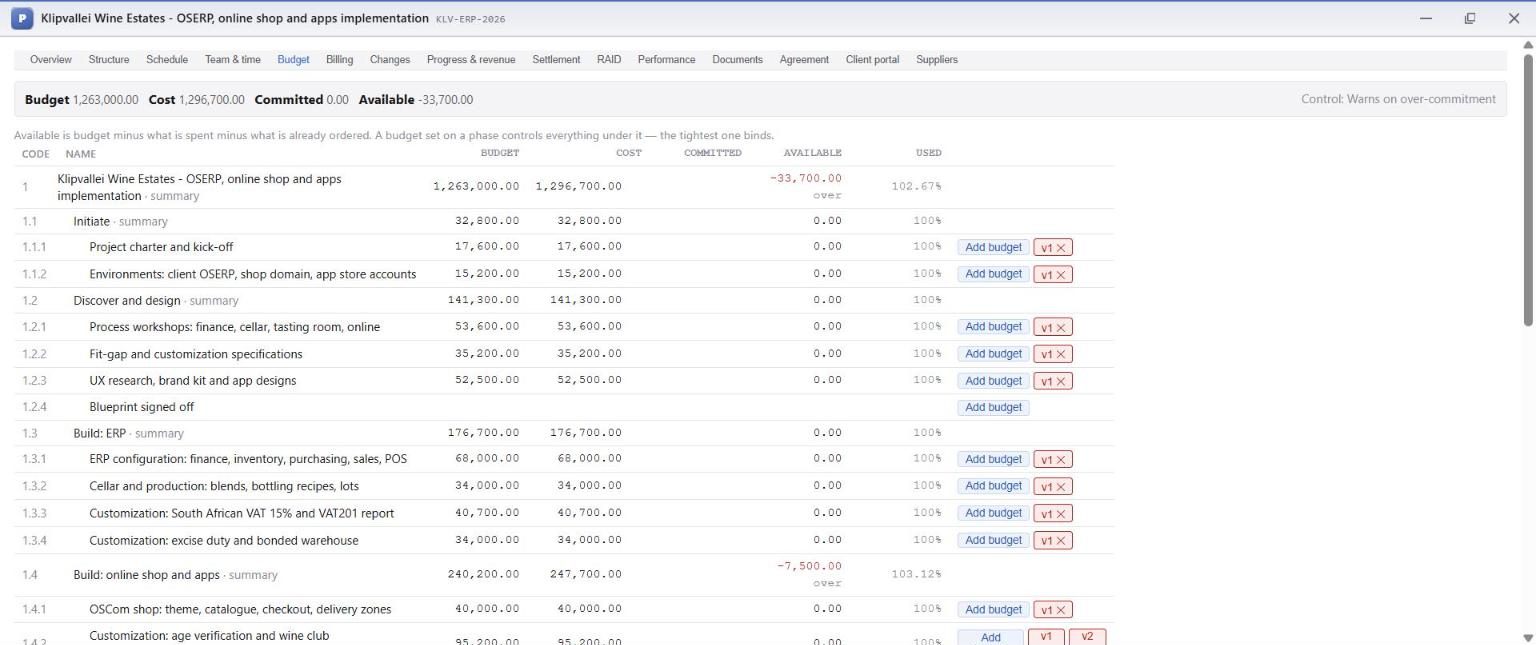
Budget lines are movements
A budget is never overwritten. When change order CO-001 was approved (chapter 7), OSERP added its cost of 53,000 as a second line (v2) on Customization: age verification and wine club. The original line stays, so the trail from tender to final budget survives. That is why the total budget is now 12,63,000.
5.2 Hours: from timesheet to project cost
Entering time
Each consultant books their week at People & Payroll > Timesheet (My Timesheet). + Add a project or site asks What was the time spent on?: pick the project, then the step. That adds a row, and the hours go in the day's cell. Hours can be typed as 4, 4.5, 4:30 or 90m.
| Field | Example (Sanjay, week of 13 July) |
|---|---|
| Row | Project KLV-ERP-2026, step 1.5.2 The Courier Guy shipping and tracking |
| Tuesday 14 July | 6 |
| What was done | Rebuilt waybill creation on the courier's new API version |
| Billable | ticked |
Send for approval locks the week until someone decides on it. Meera approves the team's weeks, or sends one back with a reason. An approved entry is evidence behind an invoice and can no longer be changed. A week still in draft can.
Costing it to the project (Team & time tab)
Once a month, Labour costing: set Up to to the month end, then Preview shows the hours and their value at each person's cost rate. Post labour cost posts one journal:
| Debit | Credit | |
|---|---|---|
| Project Labour Cost (tagged to the project and the step) | value | |
| Labour Cost Absorbed to Projects | value |
Labour costing does not add any new cost to the company. Payroll has already posted the salaries. This journal moves the share spent on the project into the project, step by step, and the second account reduces salary expense by the same amount, so total costs do not change. Each costed hour is marked, so it can never be costed twice.
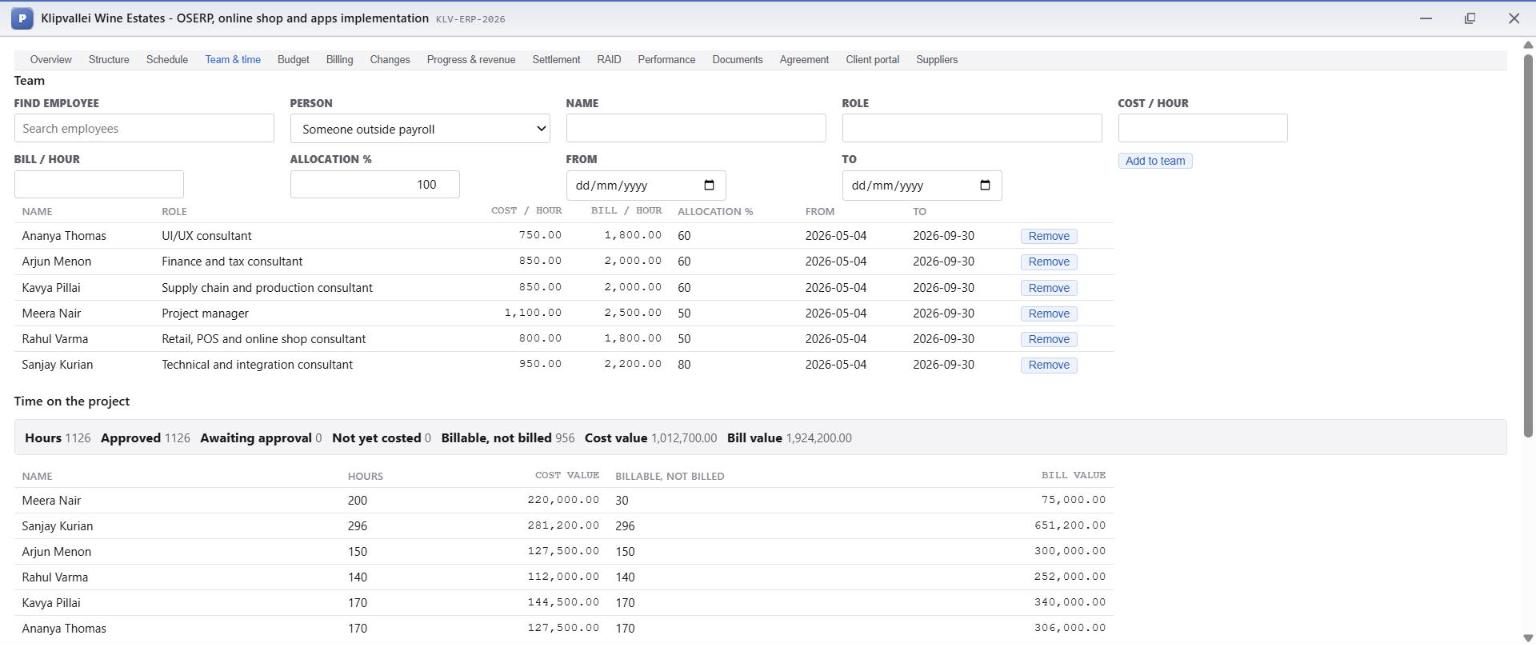
| Person | Planned hours | Actual hours | Cost value | Why the difference |
|---|---|---|---|---|
| Meera Nair | 200 | 200 | 2,20,000 | |
| Arjun Menon | 150 | 150 | 1,27,500 | |
| Kavya Pillai | 170 | 170 | 1,44,500 | |
| Rahul Varma | 140 | 140 | 1,12,000 | |
| Sanjay Kurian | 220 | 296 | 2,81,200 | +24 courier API rework, +12 importer feed, +40 change order CO-001 |
| Ananya Thomas | 140 | 170 | 1,27,500 | +10 App Store resubmission, +20 change order CO-001 |
| Total | 1,020 | 1,126 | 10,12,700 |
The panel also shows Billable, not billed hours and their Bill value at each person's bill rate: 19,24,200 here. On a fixed-price contract they are not invoiced. The figure shows what the same work would have earned at time-and-materials rates.
5.3 Purchases: order, bill, pay
Every purchase for the project goes through Purchasing - A/P > Unified Purchase Workspace, the same flow the company uses for any purchase. Two fields make it a project cost:
| Field | Entered | Why |
|---|---|---|
| Project | KLV-ERP-2026 | The cost appears on the project. |
| WBS element (Dimensions, under Show header) | the step it serves, for example 1.4.3 Android and iOS apps | The cost lands on that step's budget line. |
The stages used here:
- Purchase Request: vendor, lines (description, quantity, unit, unit price) and Tax % (18 for an Indian supplier's GST, 0 for pass-through travel).
- Purchase Order: the order is placed. The amount becomes Committed on the step's budget. This is the moment to look at Available: the order is a promise, and an overspend seen at the bill is too late to change anything.
- AP Invoice: the supplier's bill arrives. Enter its number in Vendor ref. no. and choose the lines and quantities billed. The commitment turns into cost. The GST goes to input credit, not to the project.
- Vendor Payment: the bank payment, with the payment mode and reference.
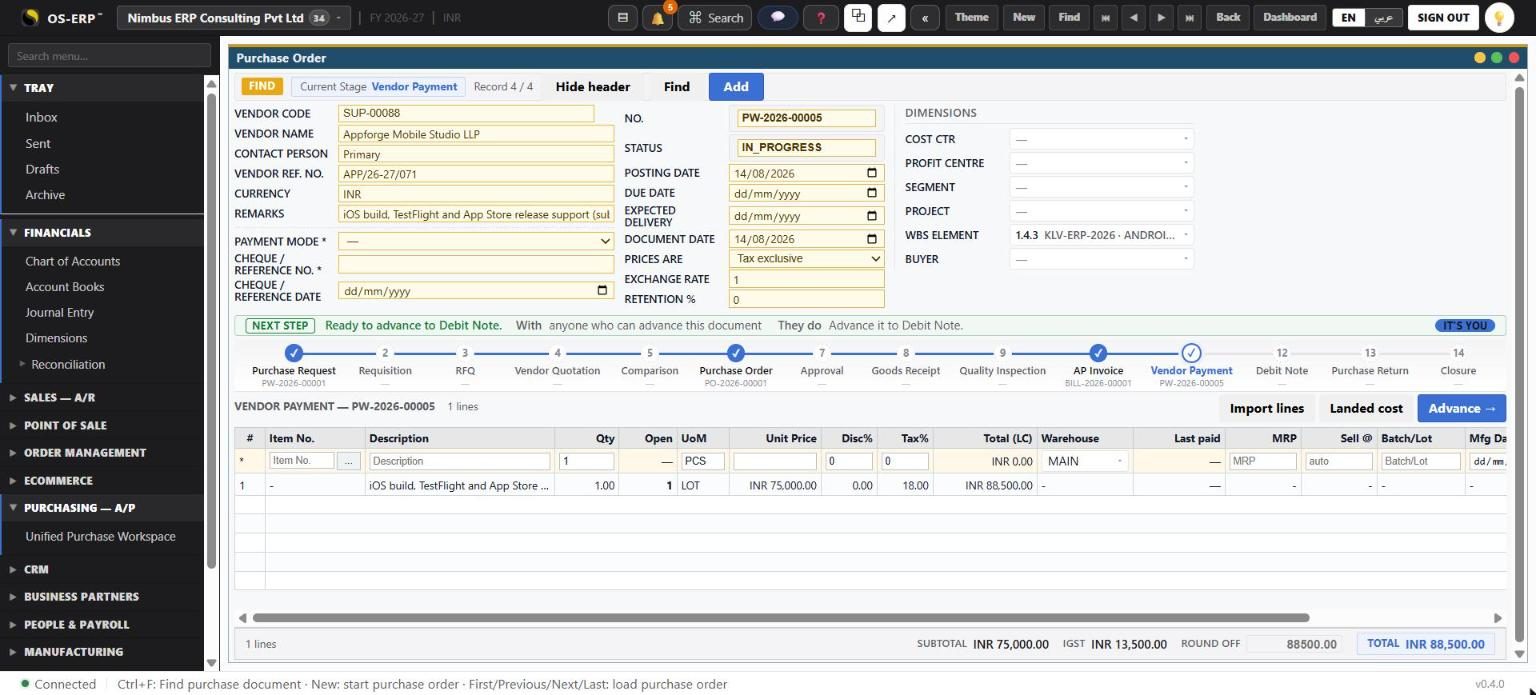
| Order | Supplier | Ordered | Bill | Net (project cost) | GST (input credit) | Paid |
|---|---|---|---|---|---|---|
| PO-2026-00001 | Appforge Mobile Studio LLP | 1 Jul | BILL-2026-00001, 31 Jul | 75,000 | 13,500 IGST | 14 Aug |
| PO-2026-00002 | Signalbird Messaging Pvt Ltd | 15 Jul | BILL-2026-00002, 20 Jul | 12,000 | 1,080 CGST + 1,080 SGST | 31 Jul |
| PO-2026-00003 | Kestrel Security Labs Pvt Ltd | 20 Jul | BILL-2026-00003, 7 Aug | 45,000 | 4,050 CGST + 4,050 SGST | 28 Aug |
| PO-2026-00004 | Skyline Travel Services Pvt Ltd | 5 Aug | BILL-2026-00004, 25 Aug | 1,52,000 | none | 28 Aug |
| Total | 2,84,000 | 23,760 |
Travel came in 8,000 under its 1,60,000 budget. The other three were billed exactly as ordered.
GST on an exporter's purchases
Nimbus's invoices carry no GST, so it has no output tax to set the 23,760 of input credit against. An exporter under LUT can claim the unused credit as a refund. Keep the suppliers' GSTINs correct on the vendor master (chapter 2). A bill booked against a vendor with the wrong state or no GSTIN loses the credit.
5.4 What the project cost
| Budget | Actual | |
|---|---|---|
| Labour (1,126 hours) | 9,71,000 | 10,12,700 |
| Purchases | 2,92,000 | 2,84,000 |
| Total (budget includes CO-001's 53,000) | 12,63,000 | 12,96,700 |
| Over budget | 33,700 |
The overrun is 41,700 of extra hours (courier API 22,800, importer feed 11,400, App Store resubmission 7,500), less the 8,000 saved on travel. The Budget tab showed each extra hour on the step that caused it, in the month it was costed.
What this chapter meant for the money
The costs came in from two directions, people's hours and suppliers' bills, and both landed on the same budget lines. Meera never had to rebuild a spreadsheet to know where the project stood. The 33,700 overrun was visible in July, two months before the end, while there was still time to recover it (chapter 7).