
Appearance
1. The business and the law
Back to the case study · Next: 2. People, photographs, papers and duties
1.1 The legal form
Vigilon is a proprietorship: Anitha Raj owns it, and its income is her income. Three things follow, and OSERP asks for the legal form so it can apply them:
- GST on security services is reverse charge. When a proprietor (any supplier that is not a body corporate) supplies security services to a registered company, the company pays the GST (Notification 29/2018-Central Tax (Rate)). Vigilon still registers for GST because it bills trusts and associations, who are not covered by reverse charge.
- Labour law does not care about the legal form. PF, ESI, bonus, gratuity and the rest apply by headcount, the same as for a company.
- The owner is not an employee. Anitha takes drawings, not a salary, so she is not on the payroll.
Administration > Company > Company Profile: Kerala, GST state code 32, GSTIN, base currency INR, financial year from April.
1.2 The trade, as data: workforce packs
OSERP has no "security company module". People & Payroll is the same for every business; what makes it a security company's is data, applied from a workforce pack. Administration > Module Settings > People & Payroll > Workforce Setup > Packs offers one per trade: an office, a shop, a restaurant, a factory, a builder, security, facility management, nursing, a staffing agency, overseas recruitment, logistics, a school, IT services.
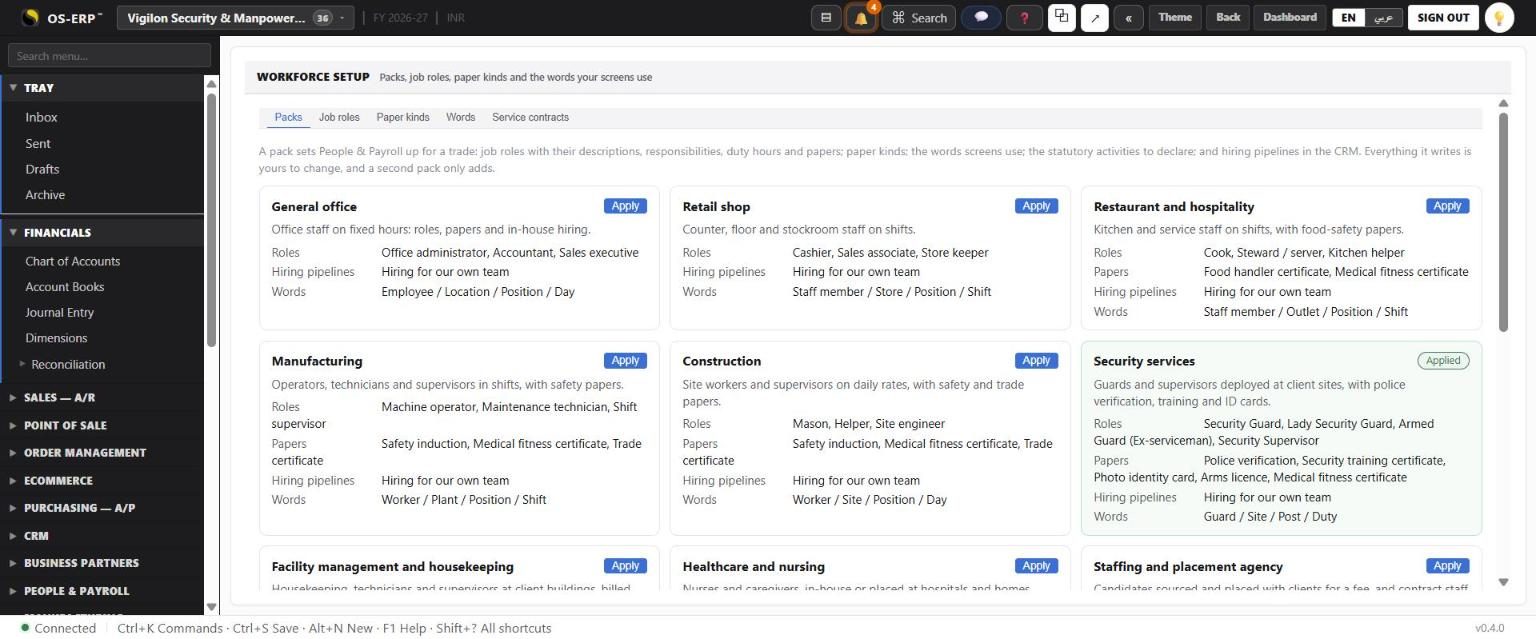
Vigilon applied two: Security services and Overseas recruitment. Between them they wrote:
| What | For Vigilon |
|---|---|
| Job roles | Security Guard, Lady Security Guard, Armed Guard (Ex-serviceman), Security Supervisor, Recruitment Executive: each with what the job is, its responsibilities, duty hours and the papers it needs |
| Paper kinds | Police verification, security training certificate, photo identity card, arms licence, medical fitness; passport, visa, medical report, emigration clearance and air ticket for candidates |
| Words | Guard, site, post, duty: every screen that supplies people says these instead of "employee, location, position, day" |
| Hiring pipelines in the CRM | Hiring for our own team; Placing workers abroad (chapter 7) |
| Letters | Offer, appointment, confirmation, pay revision, experience, relieving, warning, salary certificate, a deployment order and an overseas offer (chapter 2) |
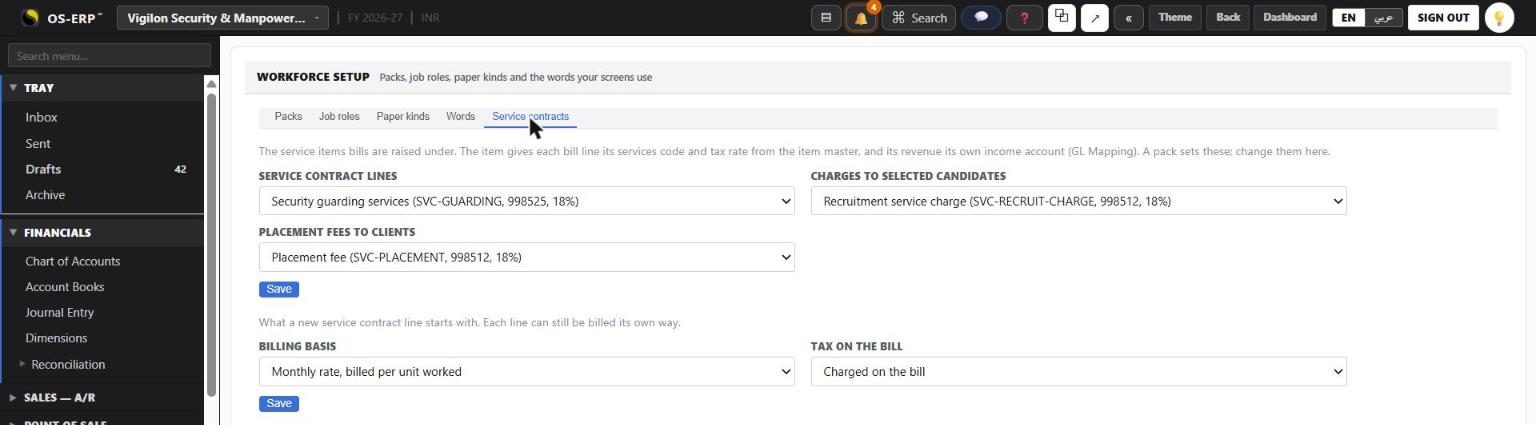
| Service items | What Vigilon bills: Security guarding services (SAC 998525), Recruitment service charge and Placement fee (SAC 998512). Each takes its tax rate from the company's SAC directory and has its own income account: Income from Security Services, Income from Recruitment Services |
| Statutory activities | Security agency, manpower supply, overseas recruitment, declared on the profile below |
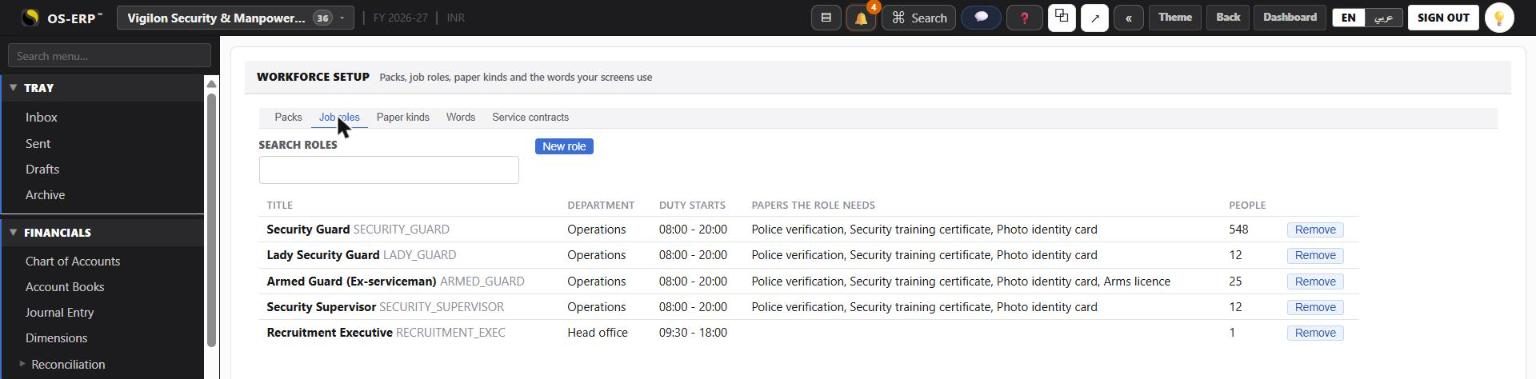
Everything a pack writes is ordinary data the company then edits, and a second pack only adds. A nursing agency would apply the Healthcare pack and get staff nurses, council registration and a placement pipeline from the same screens.
Workforce Setup > Service contracts shows which service item each kind of bill is raised under. The item decides the services code and tax rate printed on the bill and the account the income is booked to (chapters 6 and 7).
1.3 The statutory profile
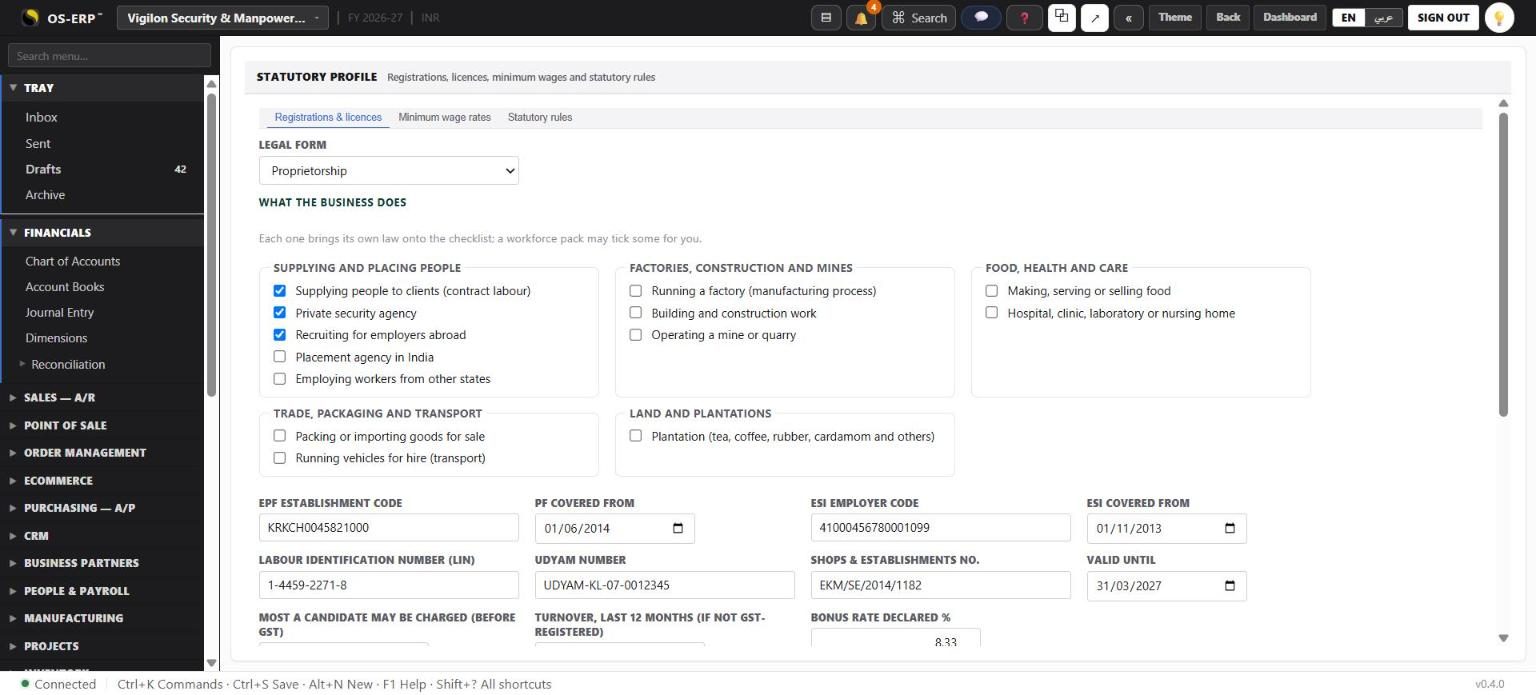
Administration > Module Settings > People & Payroll > Statutory Profile > Registrations & licences. One screen holds every registration the law asks for, with the date each one runs out. Settings live under Administration; the working screen, People & Payroll > Statutory Compliance, only reads them.
What the business does is a list for every trade, grouped by sector: supplying and placing people; factories, construction and mines; food, health and care; trade, packaging and transport; land and plantations. Each activity brings its own law: a factory its factory licence, a food business its FSSAI licence, a hospital its clinical establishment registration, a transport business its motor transport registration, a plantation its registration, a packer its legal metrology registration. Ticking one adds its licence to the Licences and registrations table, its duty to the checklist, and its expiry to the renewal calendar. Vigilon ticks three; a restaurant, a factory or a nursing home ticks its own on the same screen.
| Field | Vigilon | Why OSERP needs it |
|---|---|---|
| Legal form | Proprietorship | Reverse-charge GST; which rules apply |
| What the business does | Supplying people to clients, private security agency, recruiting for employers abroad | Each brings its own licence onto the checklist and into the licences table below |
| EPF establishment code, PF covered from | KRKCH0045821000, June 2014 | Printed on the ECR file |
| ESI employer code, covered from | 41000456780001099, November 2013 | Printed on the ESI file |
| Labour Identification Number | 1-4459-2271-8 | Shram Suvidha returns |
| Shops & establishments, valid until | EKM/SE/2014/1182, 31 March 2027 | Renewal reminder |
| Contractor licence (contract labour) | CL/EKM/2024/219, 30 November 2026 | Renewal reminder |
| Private security agency licence (PSARA), state | PSARA/KL/2022/0147, Kerala, 30 June 2027 | A guard may only be deployed under a live licence |
| Recruiting Agent certificate (eMigrate) | B-1471/KER/PER/1000+/5/10324/2023, 15 January 2028 | Printed on the careers page; required to recruit for jobs abroad |
| Most a candidate may be charged | INR 30,000 before GST | The cap hiring enforces (chapter 7) |
| Professional tax registrations | KL, KA, TN | One per state where people work |
| Labour welfare fund registrations | KL, KA (TN missing) | The checklist flags the gap |
| Bonus rate declared | 8.33% | Used by the bonus calculation |
1.4 What applies at this size
Statutory Compliance > What applies reads the headcount, the states, the activities and the registrations, and lists every obligation with its status: applies and done, applies and missing, or not yet (with the threshold that will bring it in).
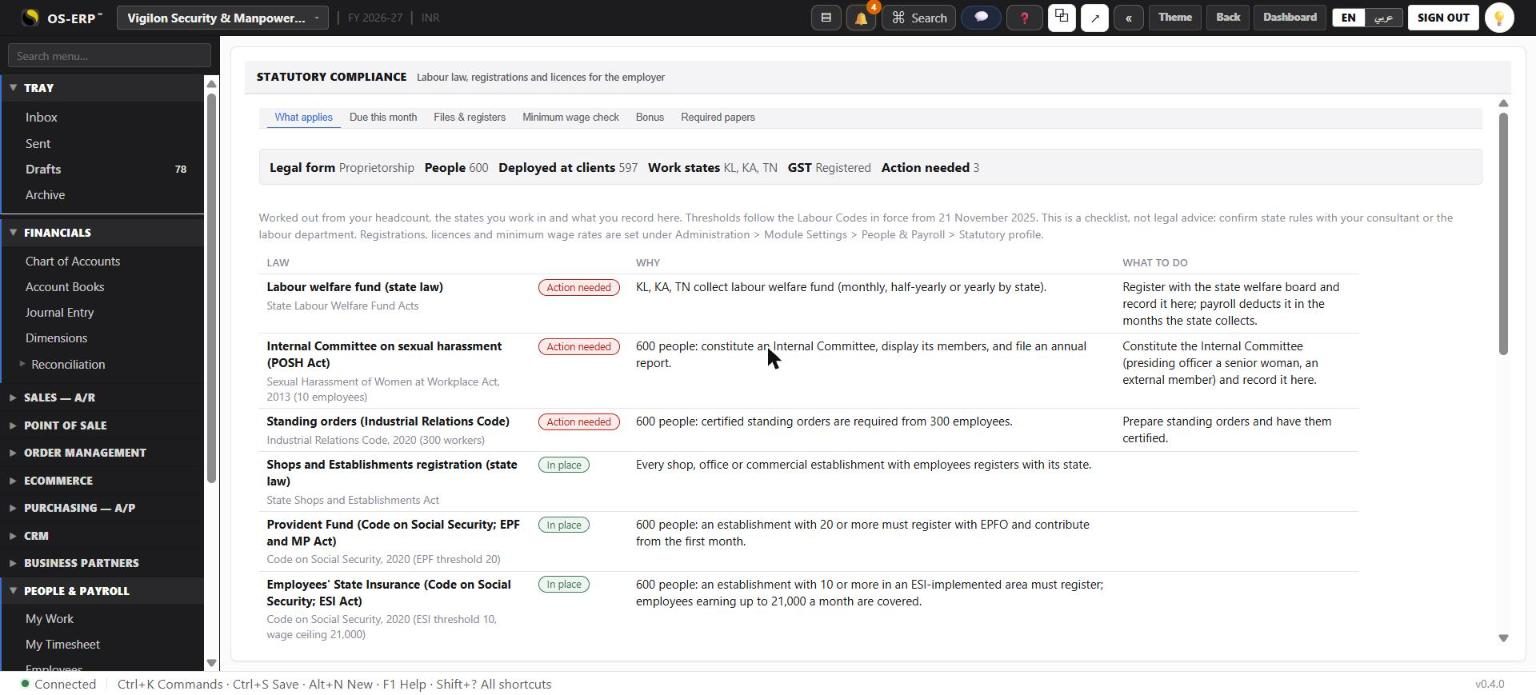
What it found for Vigilon:
| Obligation | Threshold used | Vigilon |
|---|---|---|
| PF | 20 employees | Registered |
| ESI | 10 employees | Registered |
| Payment of Bonus | 20 employees | Applies; rate declared |
| Gratuity | 10 employees | Applies; provided for monthly |
| Internal Committee (POSH) | 10 employees | Missing: no committee recorded |
| Standing orders | 300 workers | Missing: required at 600 |
| Contractor licence | Contract workers at client sites | Held |
| PSARA | Security agency | Held |
| Recruiting Agent | Overseas recruitment | Held |
| Professional tax, labour welfare fund | Every state employed in | LWF missing in Tamil Nadu |
| GST reverse charge | Proprietor supplying security | Applies; explained on every bill |
The thresholds follow the Labour Codes in force from 21 November 2025. Each line names the threshold it used, so the owner can check it against the current notification for their state.
1.5 The due-date calendar
Statutory Compliance > Due this month lists every filing and payment for the month, and licences about to expire.
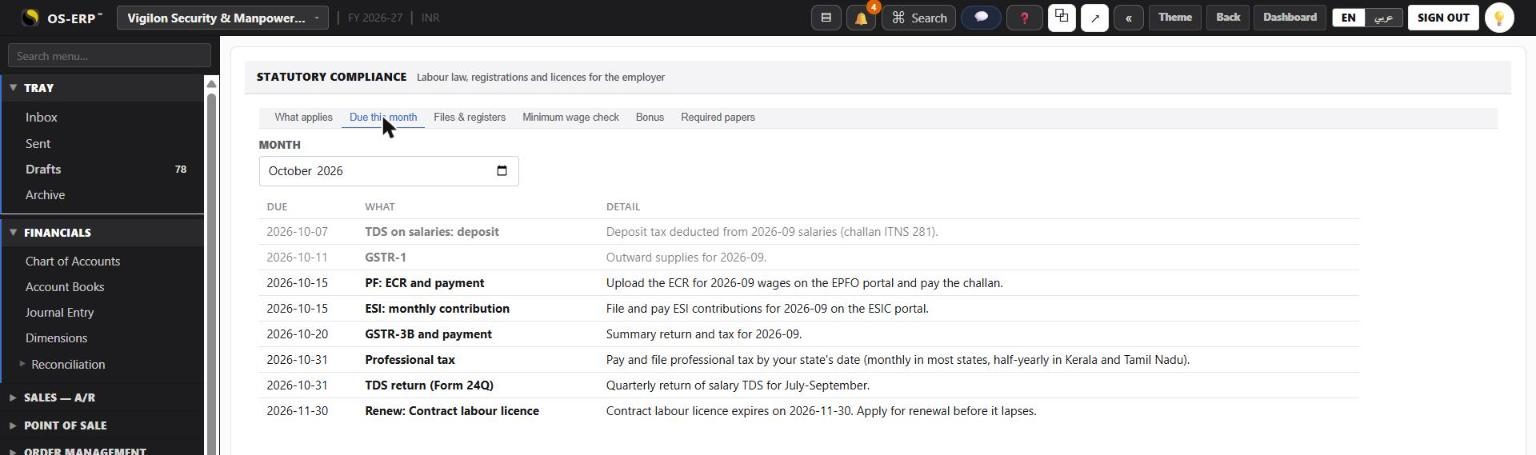
TDS by the 7th, GSTR-1 by the 11th, PF and ESI by the 15th, GSTR-3B by the 20th, and the quarterly TDS return when it falls. A licence within 60 days of expiry appears as a renewal; one already expired appears in red.
1.6 Minimum wages
Statutory Profile > Minimum wage rates: the state rate per skill category and zone, with the date it took effect. Add a row whenever the state revises it. Statutory Compliance > Minimum wage check checks each payroll run against the rate in force on its last day.
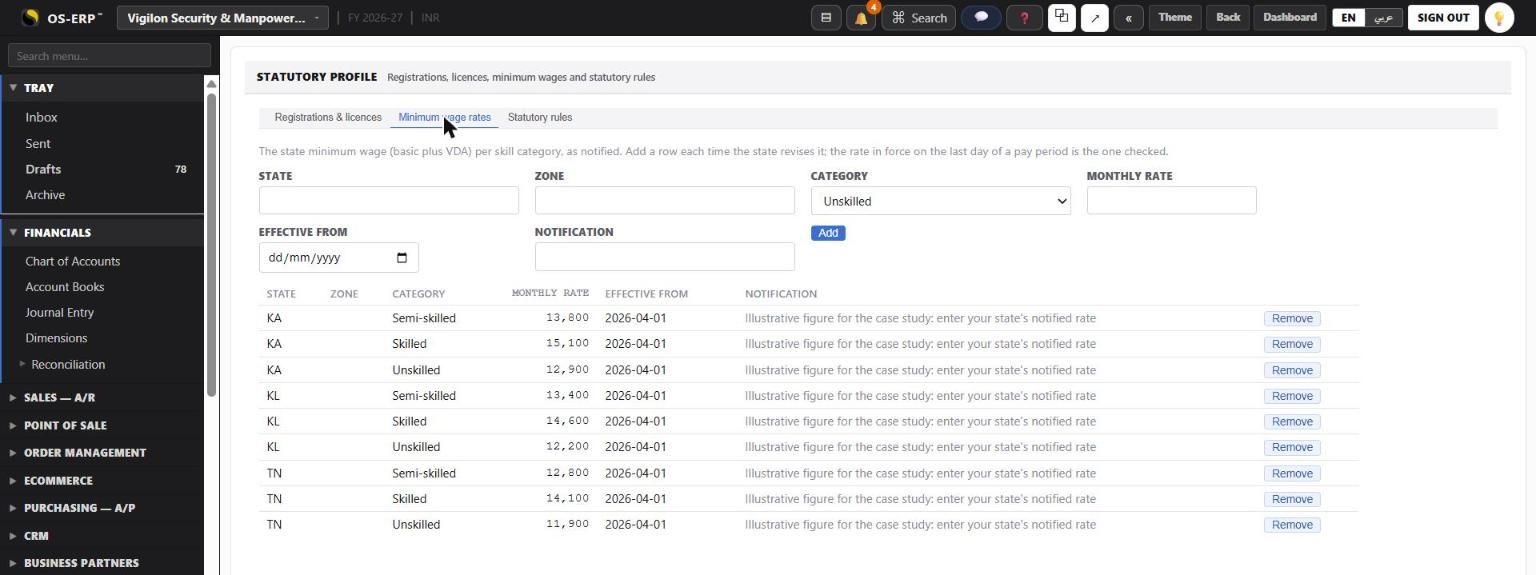
The figures here are illustrative. Enter your state's notified rates.
1.7 Kerala's professional tax
OSERP ships professional tax for the states whose slabs it can stand behind (Karnataka, Maharashtra, West Bengal, Tamil Nadu). Kerala's is levied by each local body, half-yearly, so the company enters its own: Statutory Profile > Statutory rules > Add a state levy, with the slabs from its corporation's demand notice and where they come from.
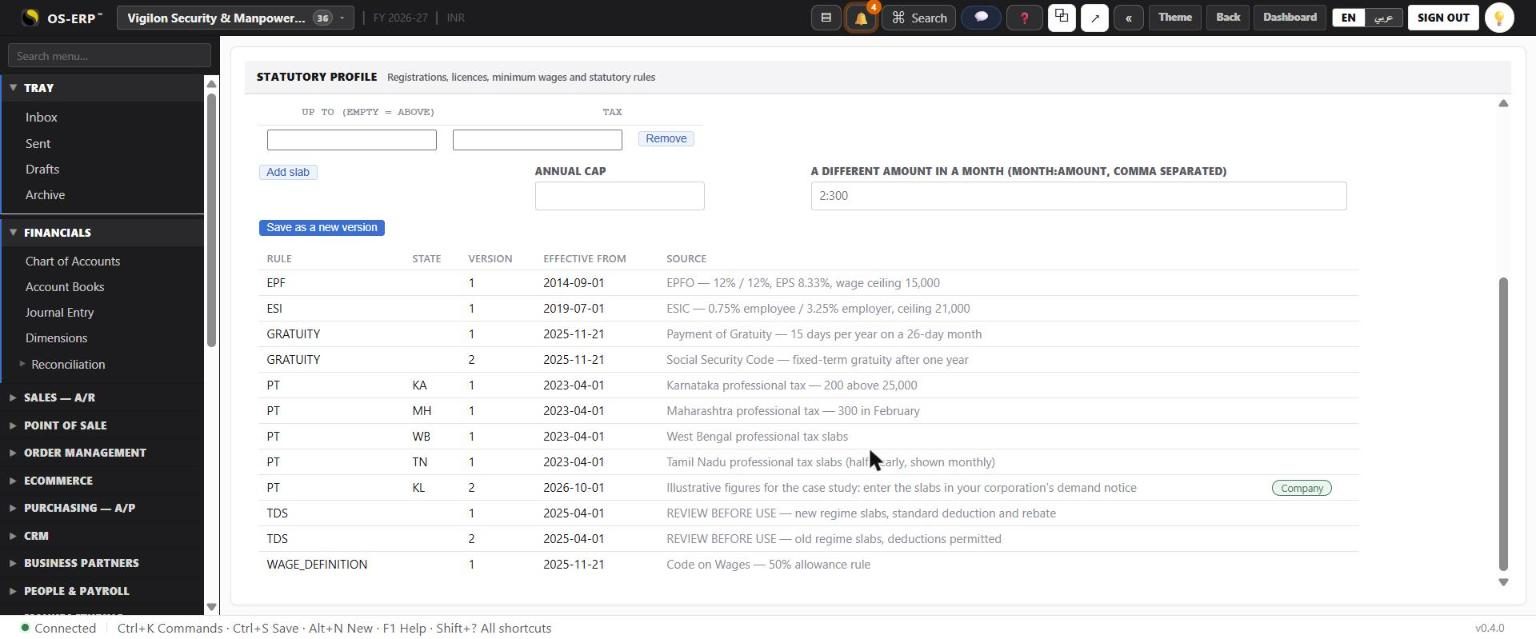
It is saved as a new version of the rule, never an edit, so last year's payslips stay as they were worked. Vigilon entered it with effect from 1 October 2026: September's payroll (chapter 5) ran before it, and its Kerala payslips say so in "Not deducted and why". From October it is deducted like any other state's. The figures in the case study are illustrative.