
Appearance
2. Items, recipes and routings
Back to the case study · Previous: 1. The business and setup · Next: 3. Planning
2.1 Three kinds of item
Inventory > Items holds 34 items, in three groups by their code:
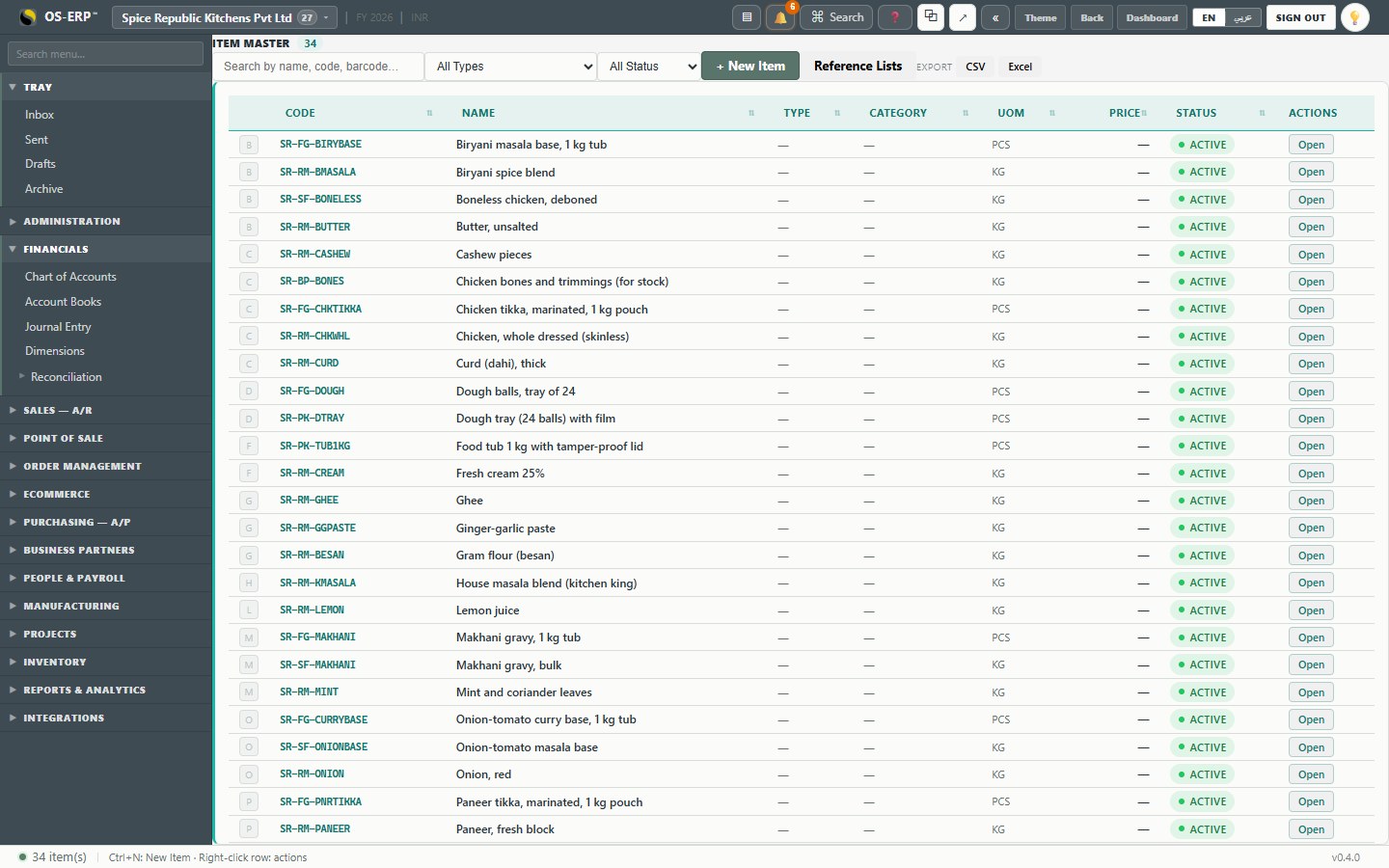
| Prefix | Kind | Examples | Unit |
|---|---|---|---|
SR-RM / SR-PK | Bought: raw food and packaging | Whole chicken, onion, tomato, cream, spice blends; tubs, vacuum pouches, dough trays | KG for food, PCS for packaging |
SR-SF | Semi-finished: made and used inside the kitchen | Boneless chicken, onion-tomato base, makhani gravy (bulk), tikka marinade | KG |
SR-FG | Outlet packs: made and sent to outlets | Makhani gravy 1 kg tub, curry base tub, chicken and paneer tikka pouches, biryani base tub, dough tray | PCS |
SR-BP | By-product | Chicken bones and trimmings, sold for stock | KG |
Three settings on every item matter for a kitchen:
- Unit. Kilograms carry three decimals (to the gram); pieces carry none. Planning and backflushing respect this: a plan never asks for 24.6 tubs, and a run never takes 1.05 of a tub out of the store.
- Batch tracked. Every receipt, every production run and every transfer carries a lot number. That is what makes recall possible (chapter 8).
- Sellable / purchasable. Raw food is purchasable and not sellable, so it never appears at an outlet's till at zero price; packs are the reverse.
2.2 A recipe is a bill of materials
Open an item, then its Production tab. This is the recipe for one batch of 100 chicken tikka pouches:
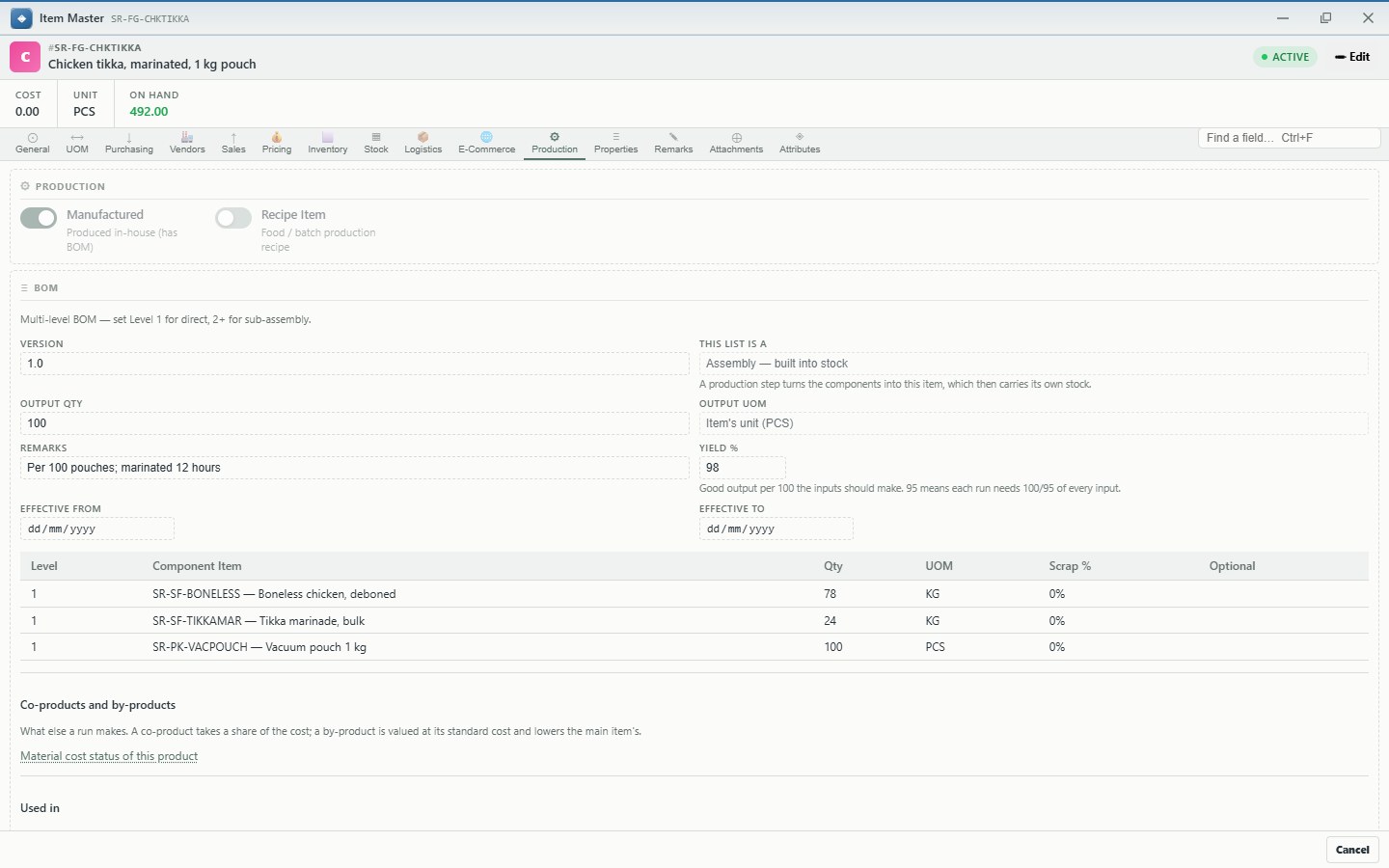
| Field | Value | Meaning |
|---|---|---|
| This list is a | Assembly | Made in a production step and kept in stock (a Kit would only be bundled at sale) |
| Output qty | 100 | The recipe is written per 100 pouches |
| Yield % | 98 | 98 good pouches come out of what should make 100: some fail the vacuum seal |
| Components | 78 kg boneless chicken, 24 kg tikka marinade, 100 pouches | What goes in |
Yield works on every input: at 98%, a good pouch needs 0.78 / 0.98 = 0.7959 kg of chicken, and 1.0204 pouches (a pouch that fails the seal is thrown away with its contents). The Manufactured switch shows the item is made in-house.
Recipes inside recipes
The chicken tikka recipe does not contain raw chicken. It contains boneless chicken, which has its own recipe:
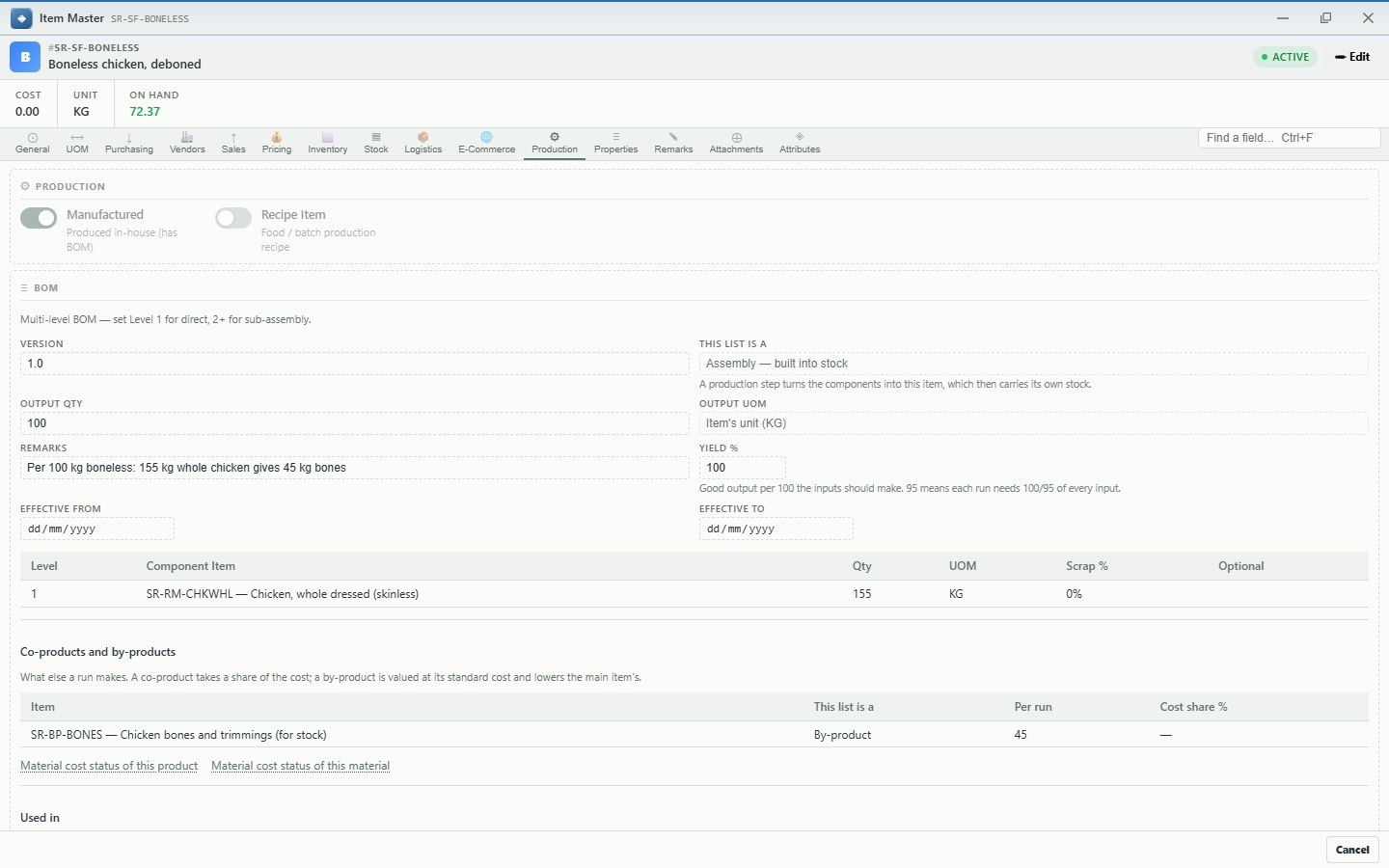
The Co-products and by-products section is the part most systems cannot do. Deboning 155 kg of whole chicken gives 100 kg of boneless meat and 45 kg of bones and trimmings, which the kitchen sells to a soup-stock maker. The bones are a by-product: valued at their own standard cost (INR 40/kg) and taken off the cost of the boneless chicken, which is what really happens to the money. A co-product would instead take an agreed share of the cost.
The onion-tomato base shows yield and scrap together:
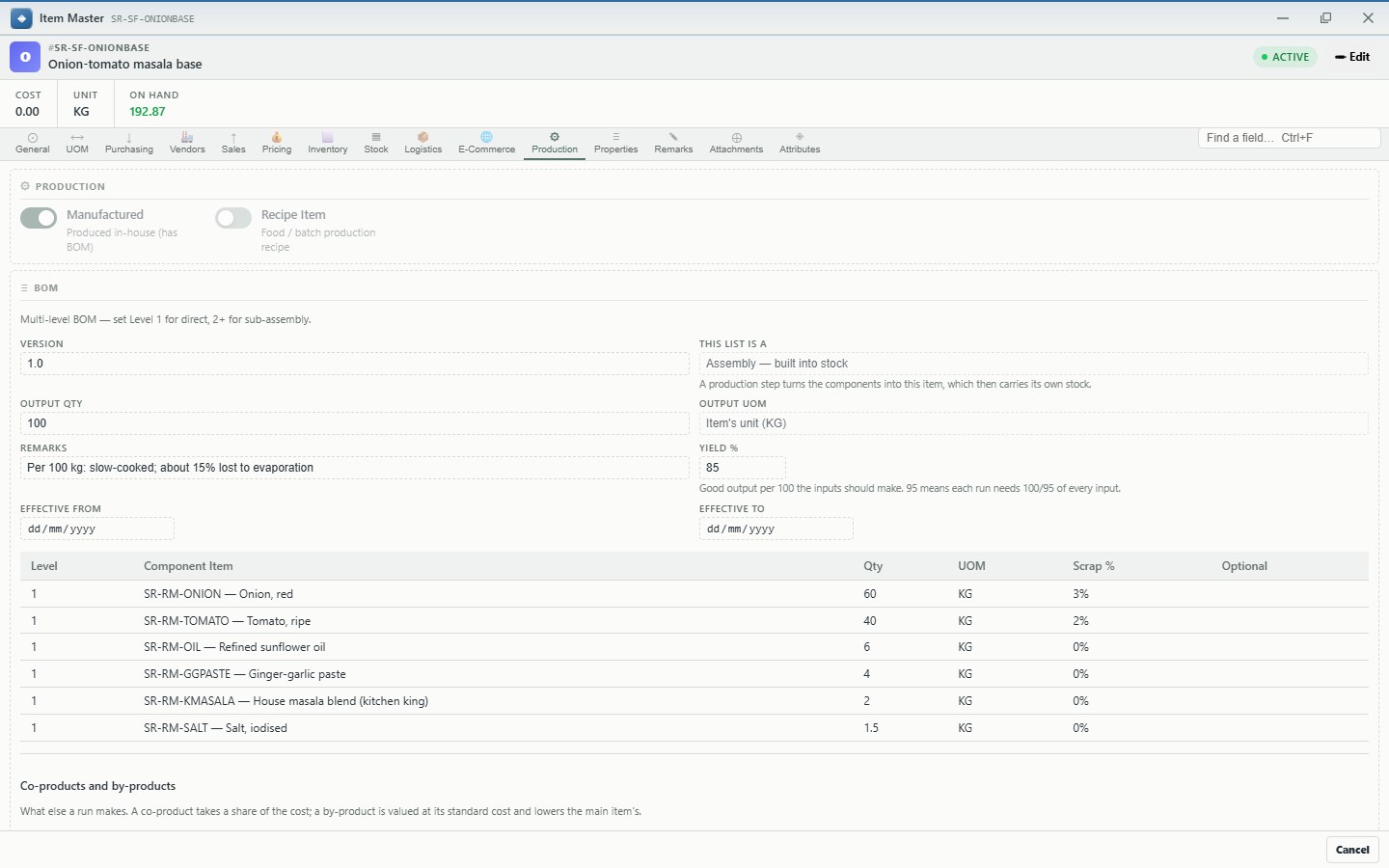
- Scrap % on a line is waste of that ingredient before cooking: 3% of onions are skins and roots, 2% of tomatoes are cores.
- Yield % on the recipe is loss in the process: slow-cooking for 90 minutes evaporates about 15% of the weight, so the yield is 85%.
So one kilogram of base needs 0.60 x 1.03 / 0.85 = 0.727 kg of onions. Getting these two numbers right is what makes the plan buy the right quantity of onions.
The full structure, four levels deep:
| Level | Item | Made from |
|---|---|---|
| 0 | Makhani gravy, 1 kg tub | Makhani gravy (bulk) + a tub |
| 1 | Makhani gravy (bulk) | Onion-tomato base, tomato, butter, cream, cashew, spices, sugar |
| 2 | Onion-tomato base | Onion, tomato, oil, ginger-garlic paste, spices, salt |
| 3 | Onion, tomato... | Bought |
2.3 Routings: the steps and their times
A recipe says what; a routing says how, where and for how long. Manufacturing > Routings, item Onion-tomato masala base:
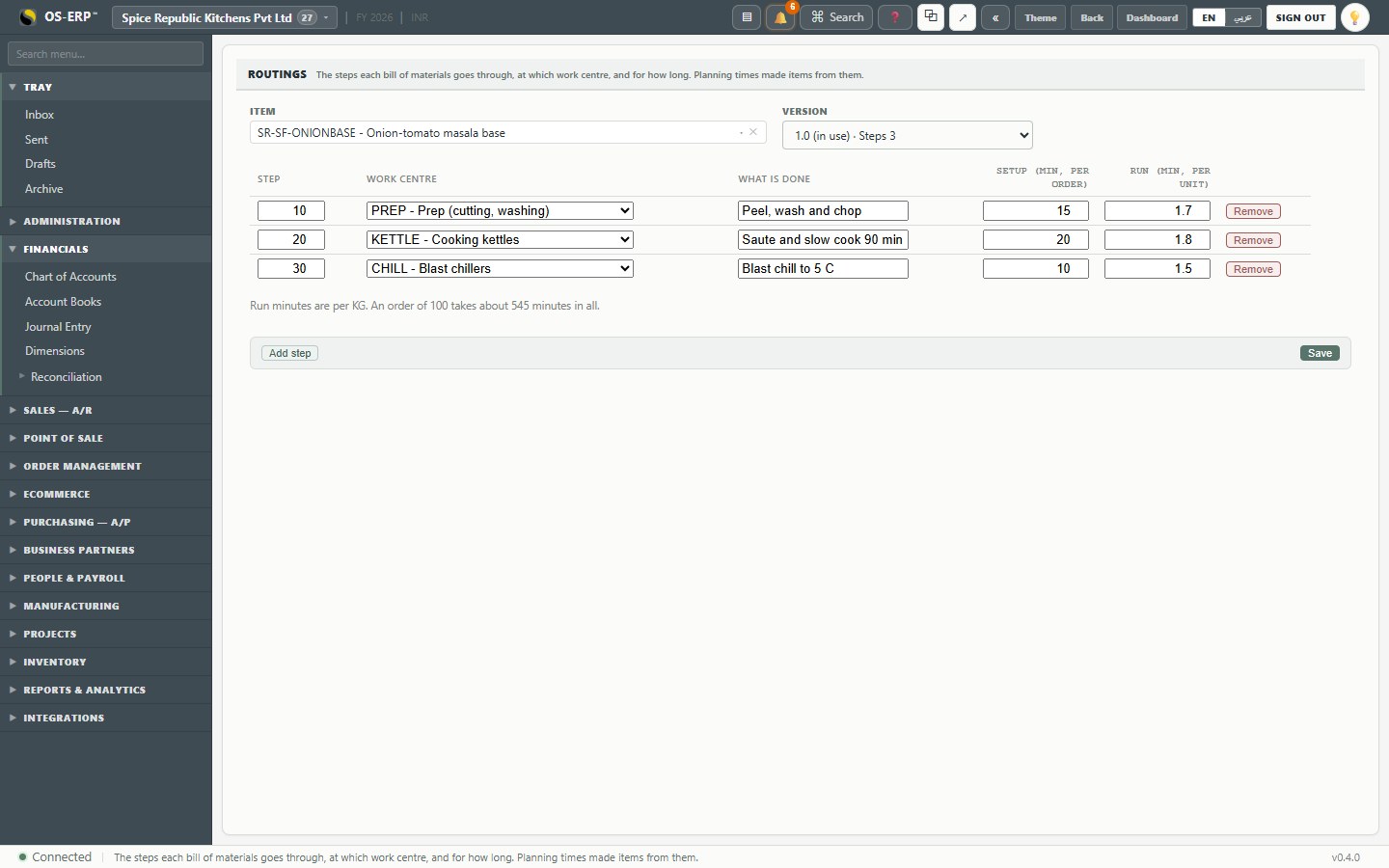
| Step | Work centre | What is done | Setup (min per batch) | Run (min per kg) |
|---|---|---|---|---|
| 10 | PREP | Peel, wash and chop | 15 | 1.7 |
| 20 | KETTLE | Saute and slow cook 90 minutes | 20 | 1.8 |
| 30 | CHILL | Blast chill to 5 C | 10 | 1.5 |
Setup is spent once per batch (cleaning a kettle, loading a chiller); run is per unit. The screen works out an example: a batch of 100 kg takes about 545 minutes of station time. Routings feed three things: the planned conversion cost of every pack, the lead time planning uses, and the load on each station.
2.4 What a pack should cost
Manufacturing > Reports > Cost roll-up, item Makhani gravy, 1 kg tub, unrolls all four levels:
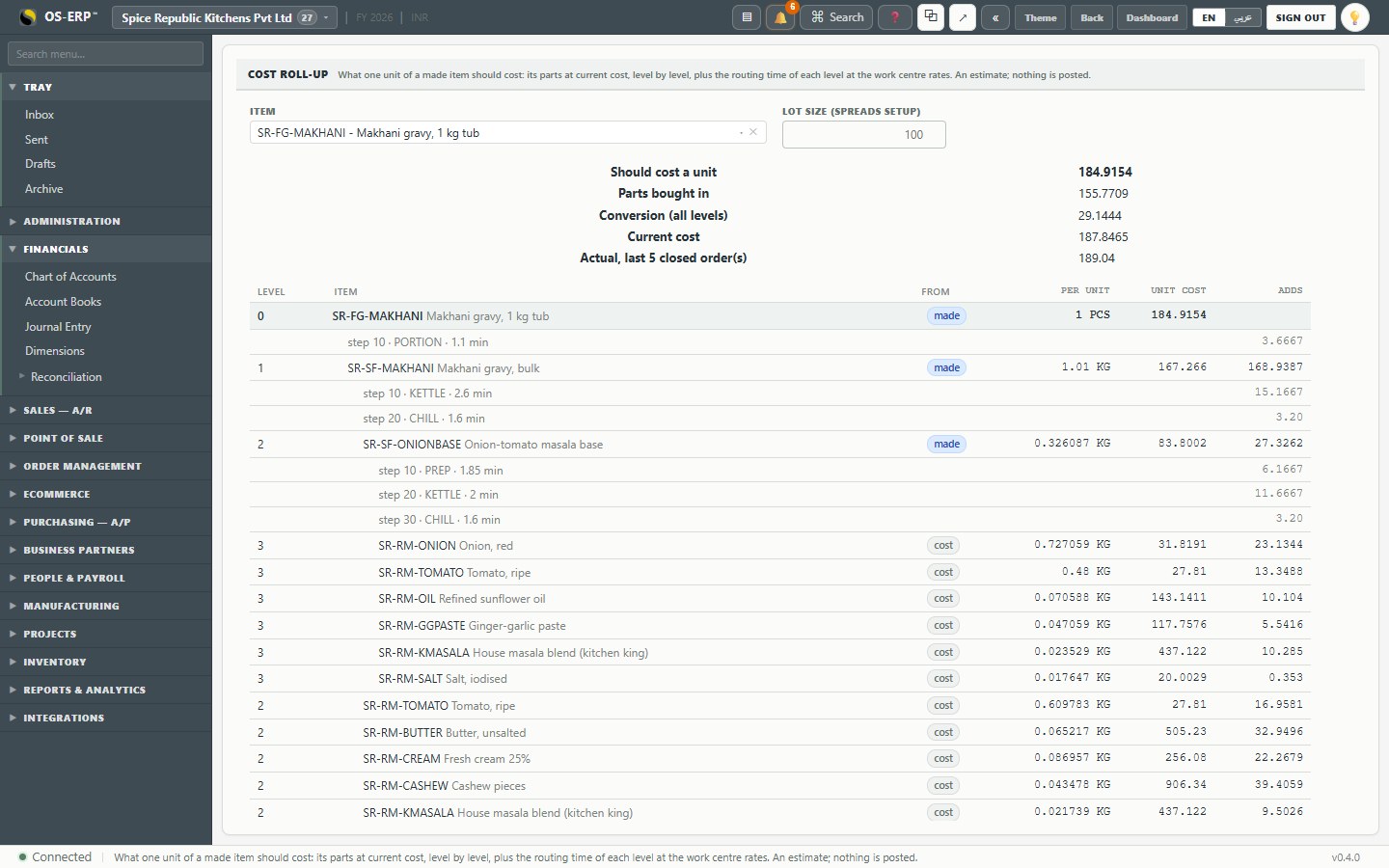
Each level shows its ingredients at their current cost (from the lots in stock) and each routing step at its station's hourly rate. The top lines compare:
| Line | Meaning |
|---|---|
| Should cost a unit | Parts at current cost plus routing time, all levels |
| Parts bought in | The raw food and packaging alone |
| Conversion (all levels) | Station time at the hourly costs |
| Current cost | What the tubs in stock are carried at |
| Actual, last 5 closed orders | What the last five batches really cost |
For the makhani tub, the gap between should cost and actual is the first thing Kavya looks at each week: if actual runs above should-cost, either a recipe is wrong or the night shift is using more than it should, and chapter 9 shows which.