
Appearance
4. The night shift: a production order from start to finish
Back to the case study · Previous: 3. Planning · Next: 5. Quality
Every night the kitchen runs about ten production orders: four semi-finished (deboning, onion-tomato base, tikka marinade, makhani gravy) and six outlet packs. This chapter follows one of them, chicken tikka, from release to close.
4.1 The order list
Manufacturing > Production Orders:
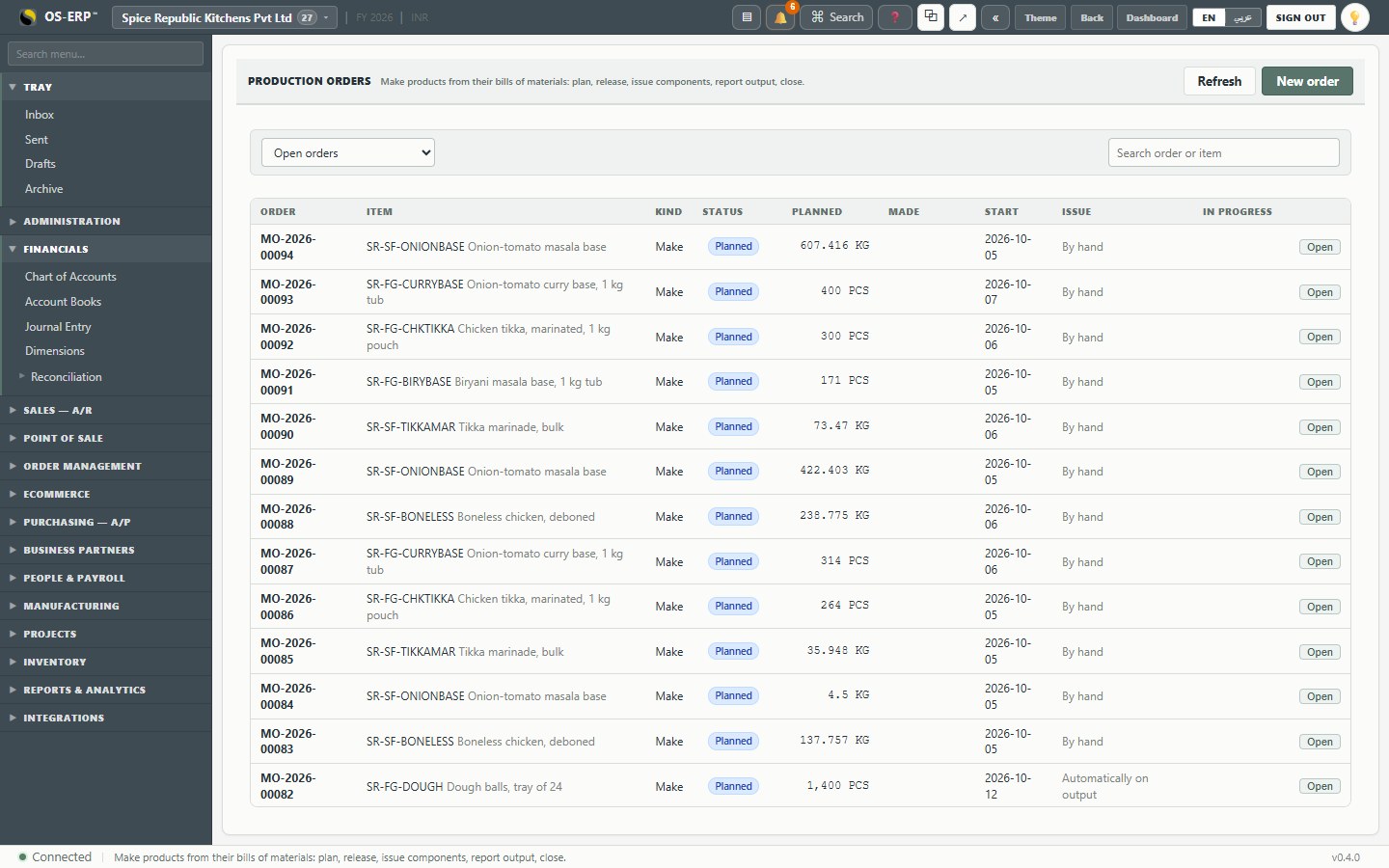
| Column | Meaning |
|---|---|
| Status | Planned, Released, In progress, Completed, Closed (or Cancelled) |
| Planned / Made | Quantity ordered and good quantity reported so far |
| Issue | By hand: a store keeper issues ingredients against the order. Automatically on output: reporting output takes what it used (backflush) |
| In progress | Value sitting in work in progress on this order |
The lifecycle is Planned -> Released -> In progress -> Completed -> Closed. Each forward step passes the company's approval policy, so a rule such as "orders over 1,000 kg need the production manager" is enforced here without anyone remembering it.
4.2 Release: the plan is fixed and stock is reserved
Releasing an order does two things:
- It fixes the planned cost: every ingredient at the cost of the lots in the store now, plus the routing time at the station rates. This is the yardstick the actual cost is measured against.
- It reserves free stock, first come first served. Two orders cannot both be promised the last 50 kg of chicken: the second one sees what the first has reserved.
A released order not yet started shows what it will take:
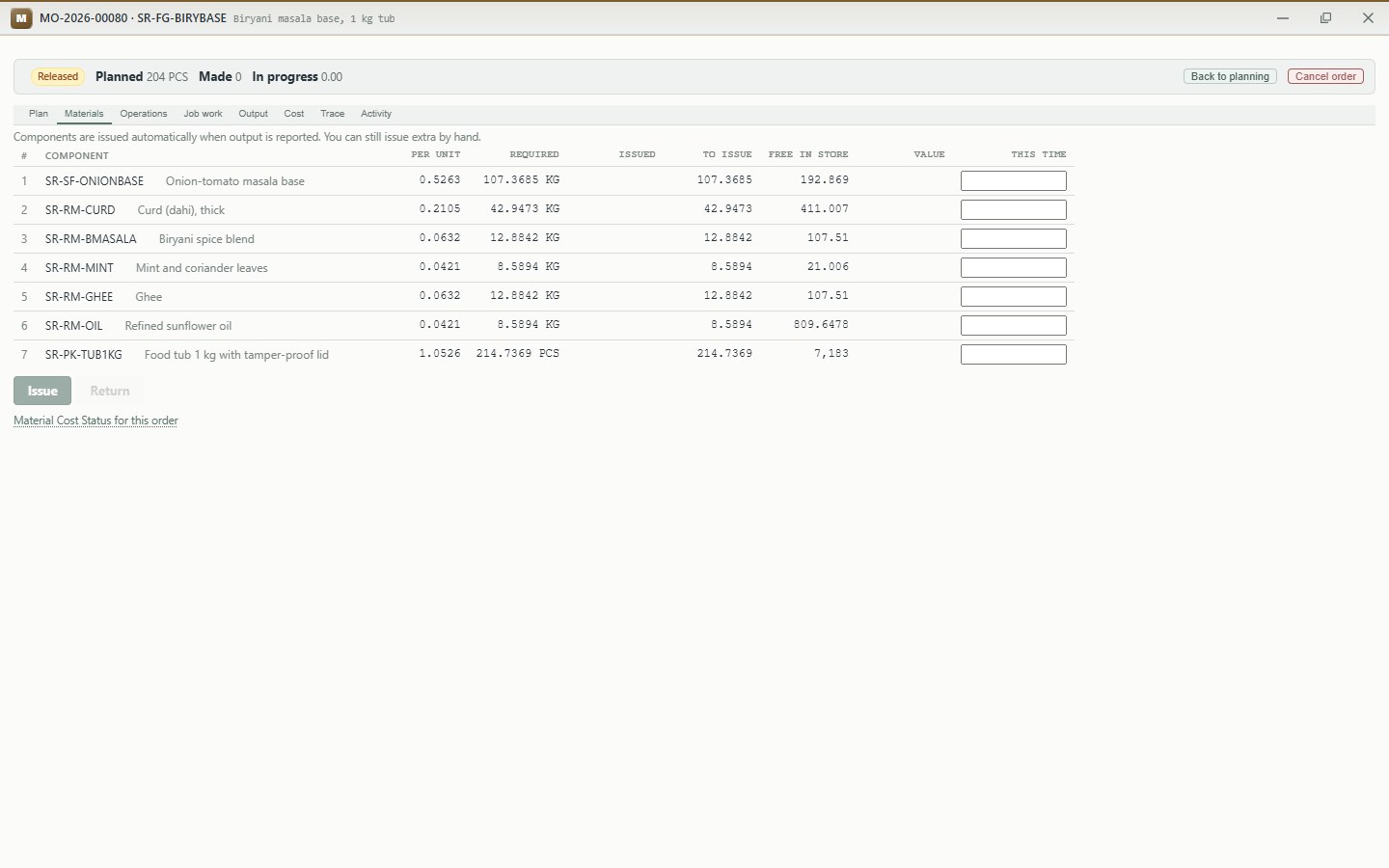
Required is per-unit quantity times the order, including yield. Free in store is what is on hand less what other orders have reserved. This time is where a store keeper types what is being issued now, if the order is issued by hand.
4.3 Issue by hand, or backflush
Spice Republic uses both:
- Deboning is issued by hand. Whole chicken is weighed out to the butchers. If a night needs more (smaller birds, more trim), issuing by hand records exactly what left the store, and the extra shows up as a usage variance the next morning.
- Everything else is backflushed. When output is reported, the order takes exactly what the recipe says that output needed. One scan does the issue and the receipt together. Pieces stay whole: if the recipe says 1.0526 tubs a tub, the order takes whole tubs so that its total never runs more than one tub ahead of the recipe.
Issues are always first-expiry-first-out (FEFO): the lot with the nearest use-by date goes first, so food is used in date order without anyone checking labels.
4.4 The finished order
Here is last night's chicken tikka order, closed:
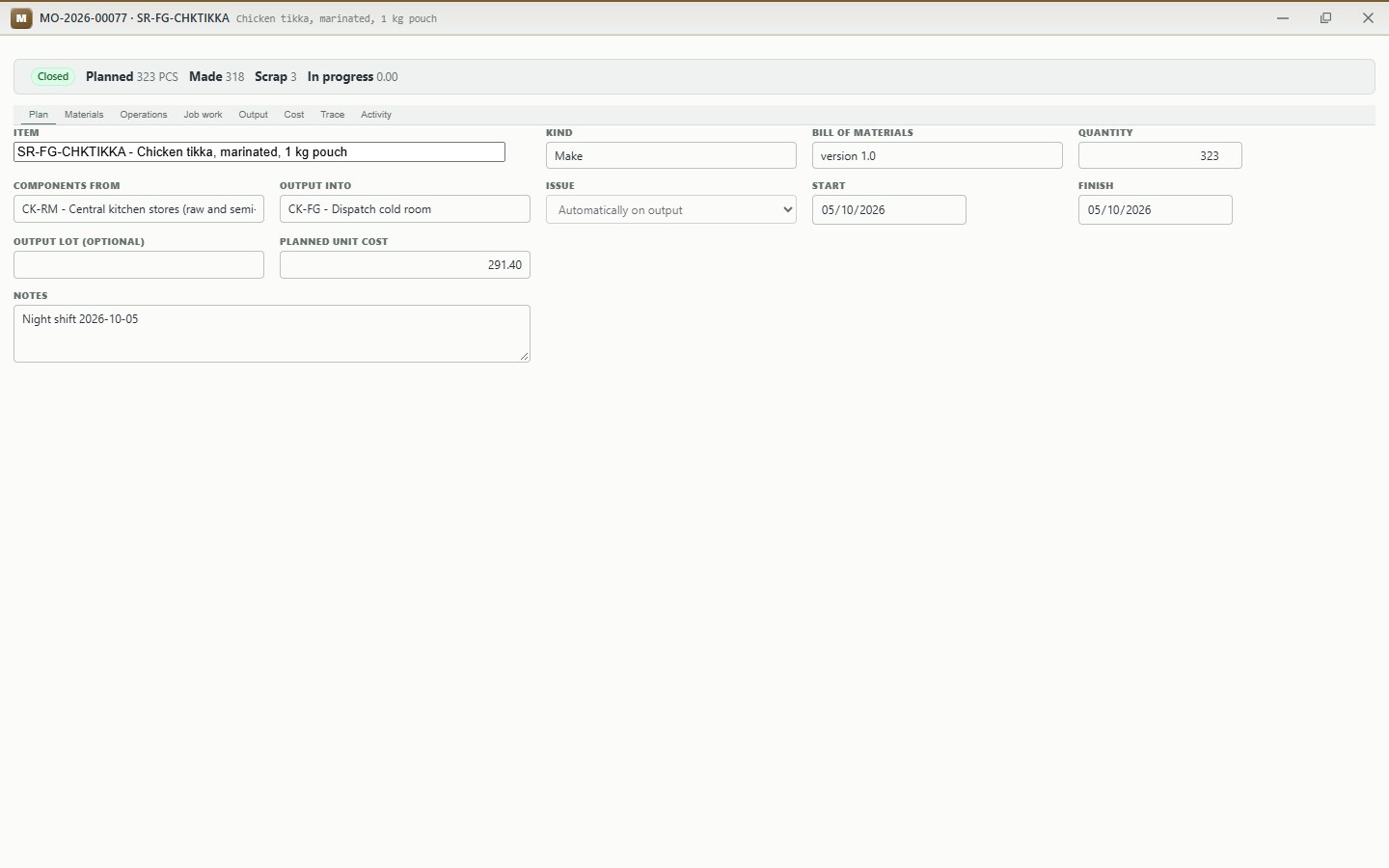
The header reads: Closed, Planned 323, Made 318, Scrap 3, In progress 0.00. The tabs tell the whole story.
Materials
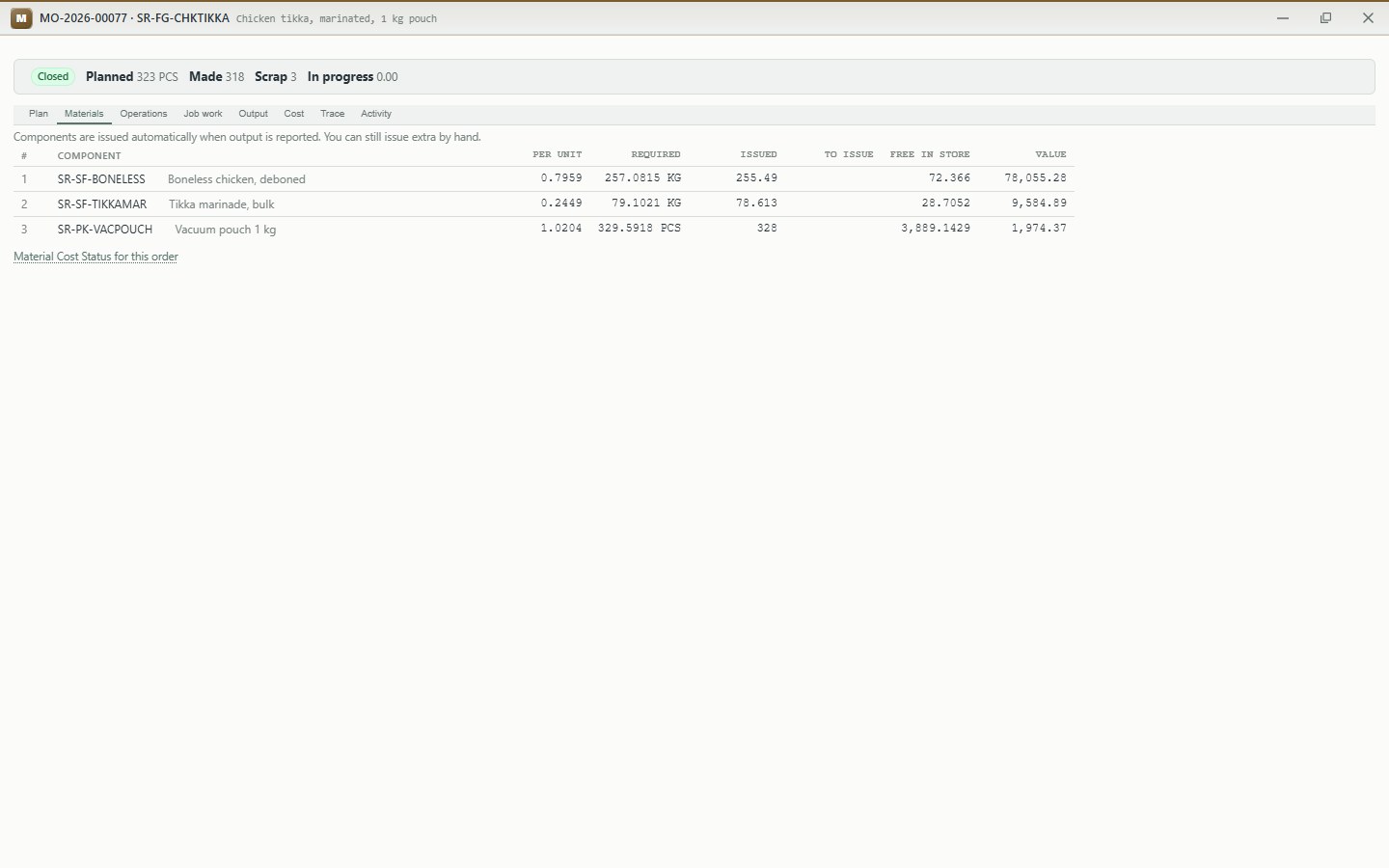
Each ingredient's per-unit quantity, what was required, what was actually issued and its value. Required is for the 323 planned; the order made 318 + 3 scrapped, so slightly less was issued.
Operations: the time at each station
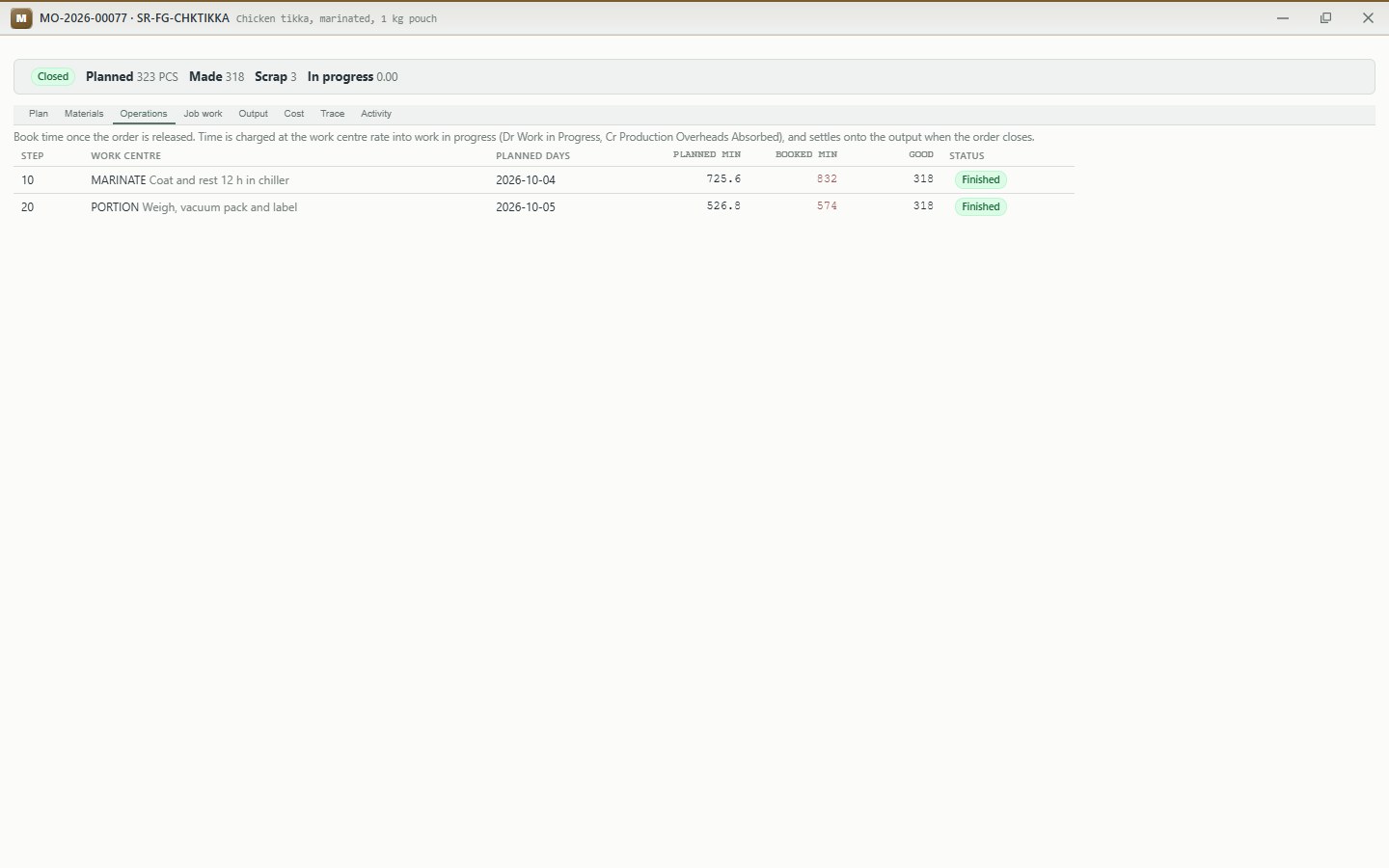
| Step | Station | Planned minutes | Booked minutes |
|---|---|---|---|
| 10 | MARINATE: coat and rest 12 h in chiller | 725.6 | 832 |
| 20 | PORTION: weigh, vacuum pack and label | 526.8 | 574 |
The shift lead books setup and run minutes against each step with the good quantity, and marks the step finished. Booked minutes above plan are shown in red. Each booking posts Dr Work in Progress / Cr Production Overheads Absorbed at the station's hourly cost, so labour and gas go into the batch as they are spent.
If nobody books time on a backflushed order, reporting output books the planned time for those units instead (a repetitive line, chapter 6, works this way). Either way the batch carries its conversion cost, and work in progress never goes negative.
Output: what was made, and into which lot
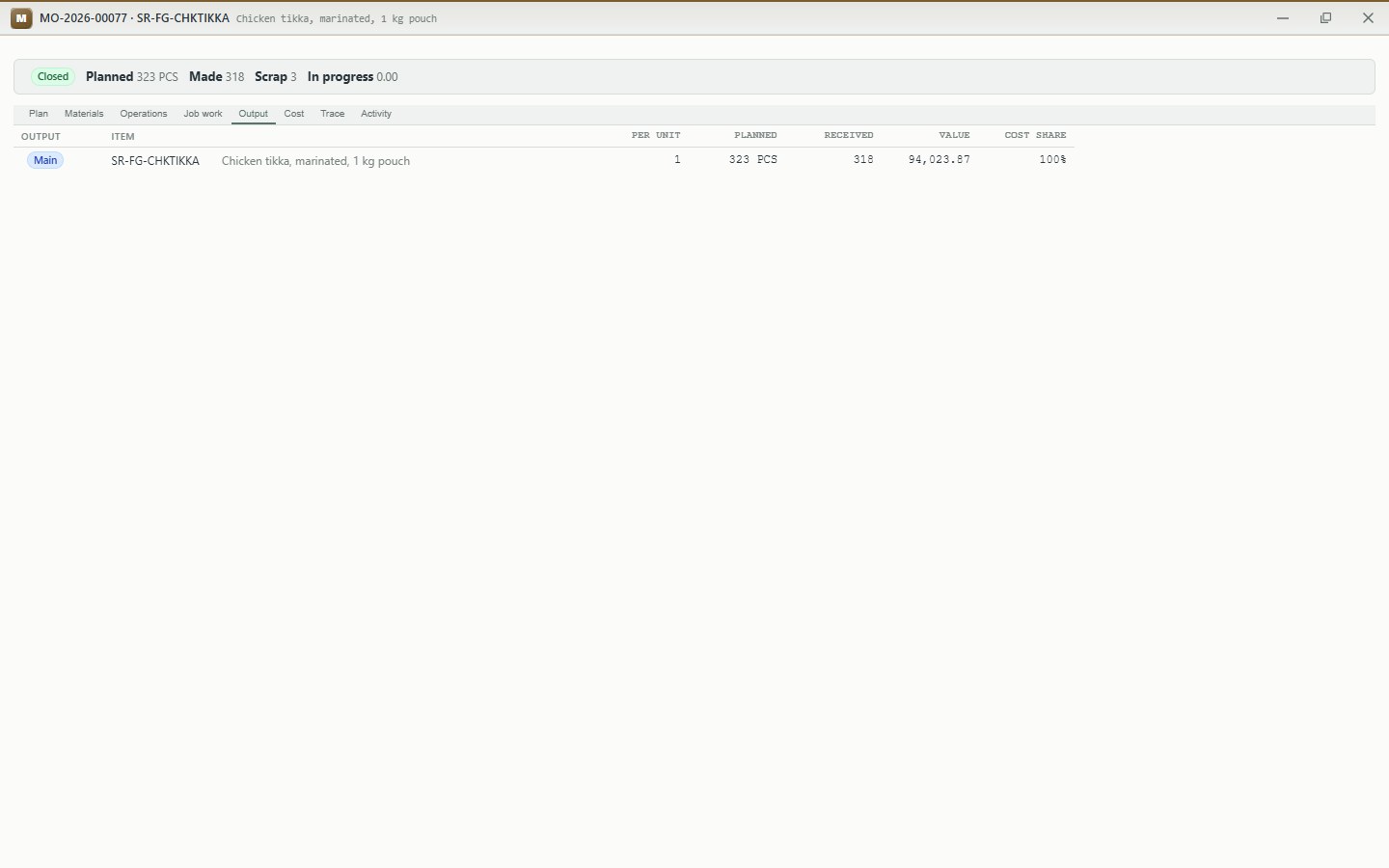
Output went into lot CHKTIK- plus the date, with the manufacture date and a use-by date three days later. Because the item has a quality plan, the pouches did not go straight to the dispatch cold room: they went to QC-HOLD until a food safety officer passed them (chapter 5).
Cost: plan against actual, and the journals
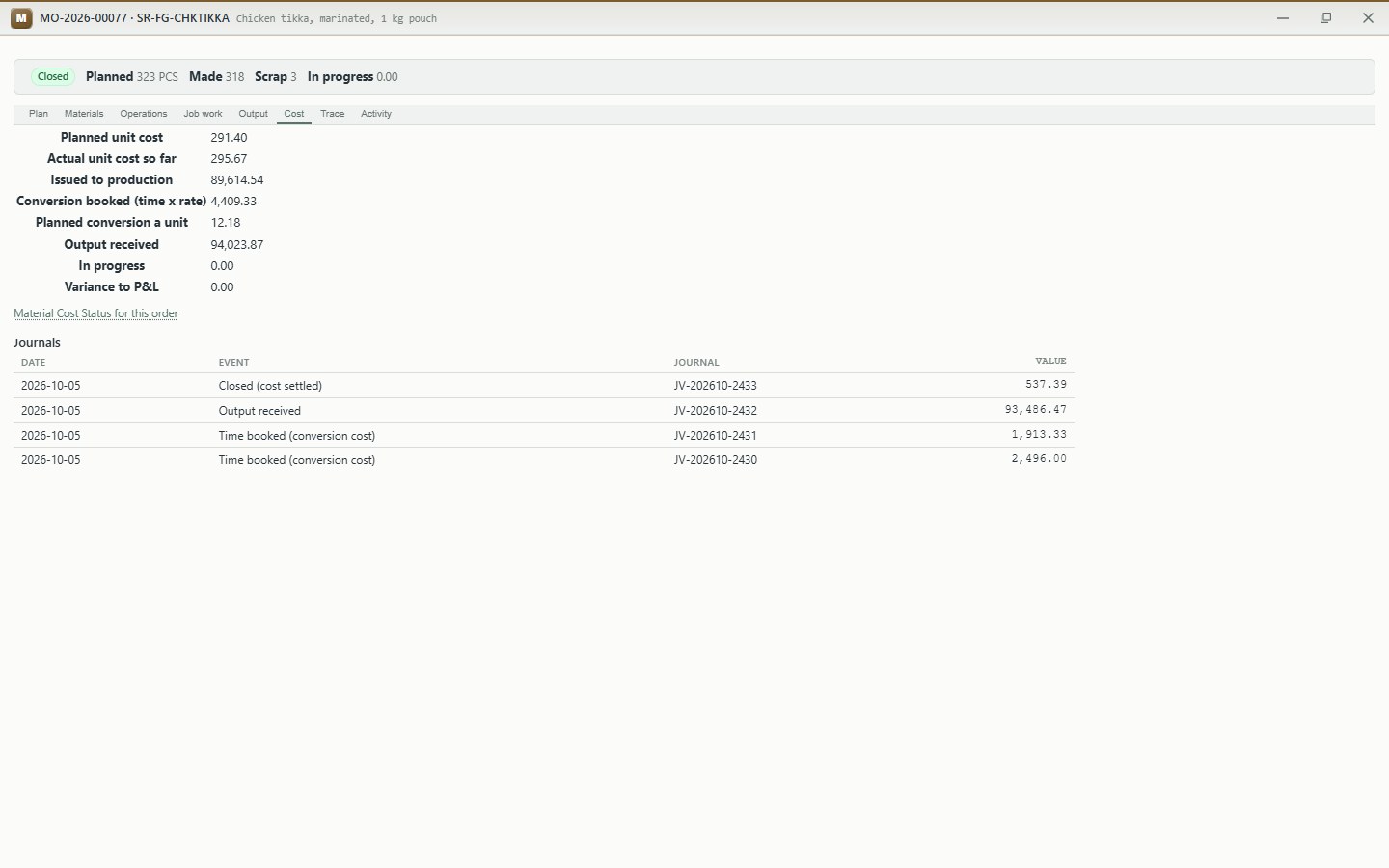
| Line | INR |
|---|---|
| Planned unit cost | 291.40 |
| Actual unit cost | 295.67 |
| Issued to production (ingredients) | 89,614.54 |
| Conversion booked (time x rate) | 4,409.33 |
| Output received | 94,023.87 |
| In progress | 0.00 |
The journals underneath, each one drillable:
| Event | What it posts |
|---|---|
| Time booked (x2) | Dr Work in Progress / Cr Production Overheads Absorbed |
| Output received | Dr Inventory (the pouches) / Cr Inventory (the ingredients backflushed) and Cr Work in Progress |
| Closed (cost settled) | What was left in work in progress goes onto the lots made, while they are still in stock |
Closing is what makes the books exact. Whatever is left in work in progress (time over plan, an extra kilo issued) is put onto the lots this order made, as long as they are still in stock, so the outlets receive the pouches at their true cost. Only a remainder that can no longer go onto stock goes to Production variance in profit and loss. After closing, work in progress for the order is exactly zero.
Trace
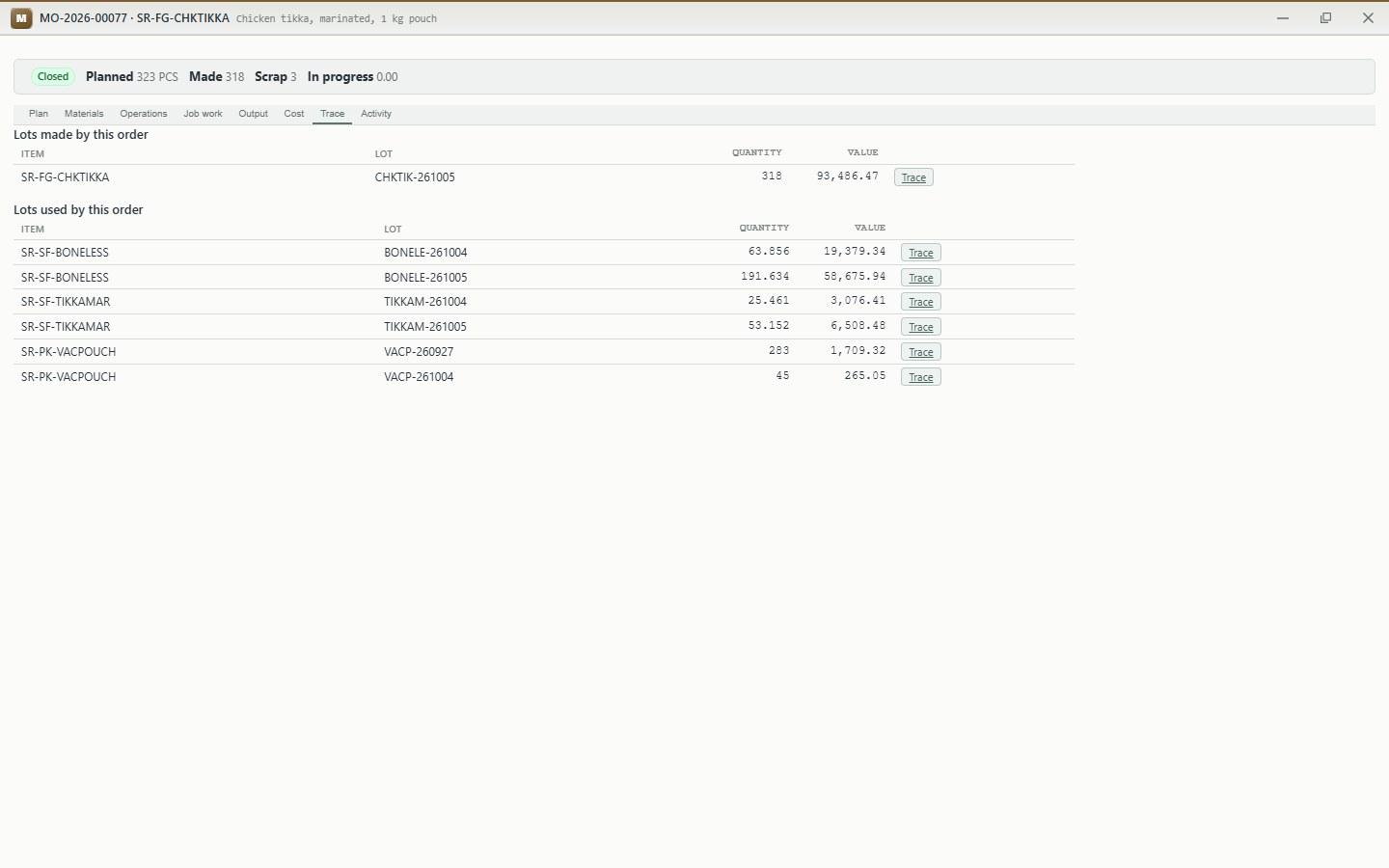
Which lots the order used (the boneless chicken and marinade from two nights, two lots of pouches) and which lot it made. Every lot is a button: it opens the lot trace (chapter 8).
4.5 An order on the floor right now
At the time of the screenshots, tonight's makhani gravy is half done:
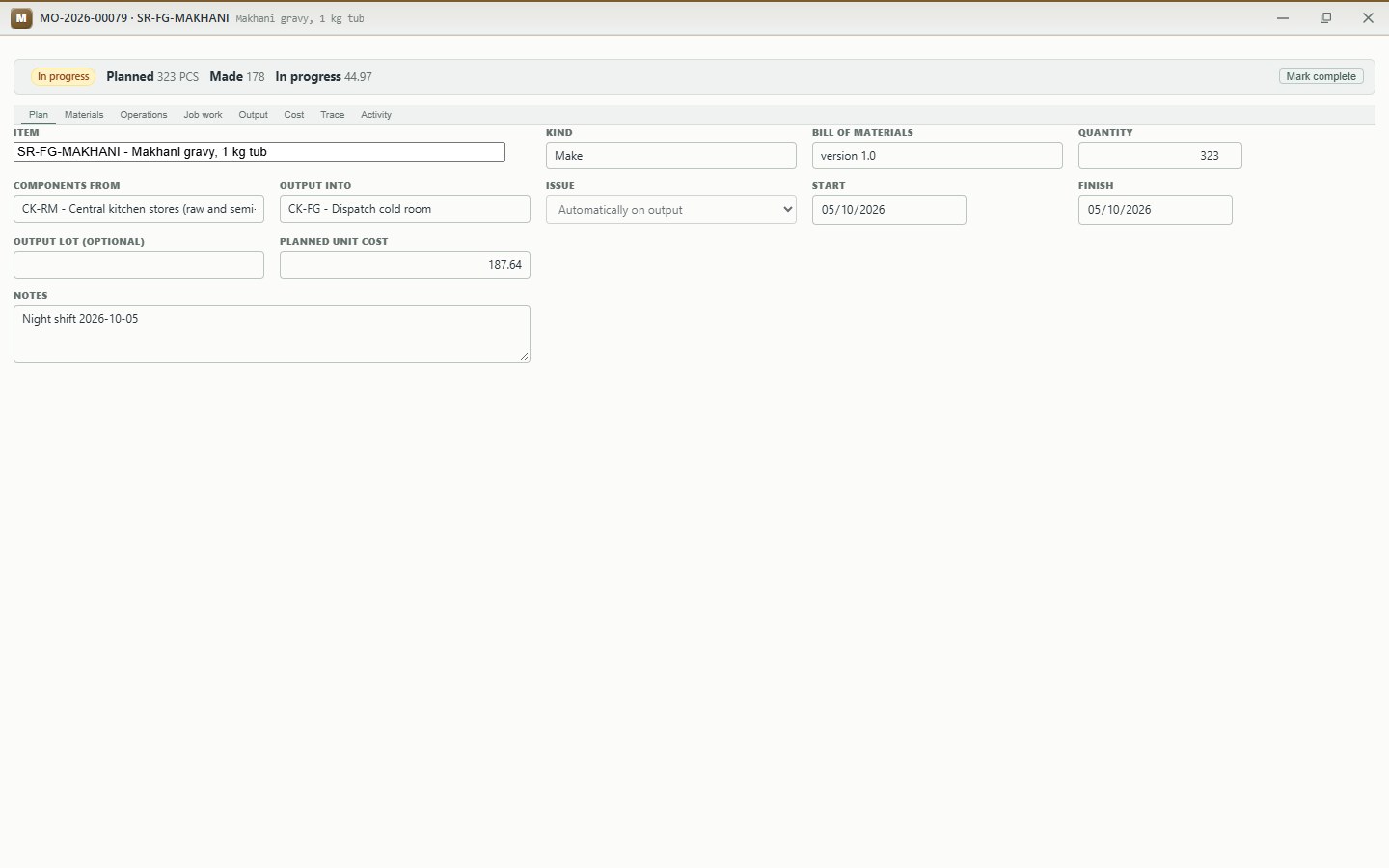
178 of 323 tubs made so far. Mark complete finishes it early, giving back reservations it no longer needs. Orders also complete themselves when good plus scrap reaches the planned quantity. Closing stays a decision for the production manager.