
Appearance
Case study: a central kitchen feeds 100 cloud kitchens
This case study follows one real week in the central kitchen of a cloud kitchen brand, step by step, through OSERP's manufacturing module. Every screenshot was taken from a working OSERP system as the week went on. Nothing is a mock-up.
It is written so that anyone can follow it: a kitchen owner, a production planner, a store keeper or an accountant. Every screen is explained field by field, and every number is explained where it comes from.
The company
Spice Republic Kitchens Pvt Ltd runs a North Indian delivery brand from 100 delivery kitchens across Bengaluru, Mysuru and nearby towns, with 500 people. The outlets do not cook from scratch. Every night, one central kitchen in Peenya debones the chicken, slow-cooks the bases, makes the gravies and marinades, kneads the dough, chills and packs everything, and sends it to the outlets by refrigerated van at 6 am.
That makes the central kitchen a food factory, with a factory's questions:
- What do we cook tonight, and what do we order from the farm for tomorrow?
- Did each batch use what the recipe says, and what did it really cost?
- Was everything cooked through and chilled in time, and did the chicken arrive cold?
- Which outlets have what, and if a lot is unsafe, where is it now?
The week at a glance
| Outlets supplied | 100, every morning |
| Production orders closed | 77 |
| Outlet packs made | 13,818 |
| Packs sent to outlets | 12,763, in 800 stock transfers |
| Value of packs sent, at full cost | INR 2,418,183.70 |
| Supplier deliveries received and inspected | 38 |
| Cost against plan | 1.32% over, INR 1.62 of it to profit and loss |
| Recall drill: one lot to every outlet holding it | Two screens |
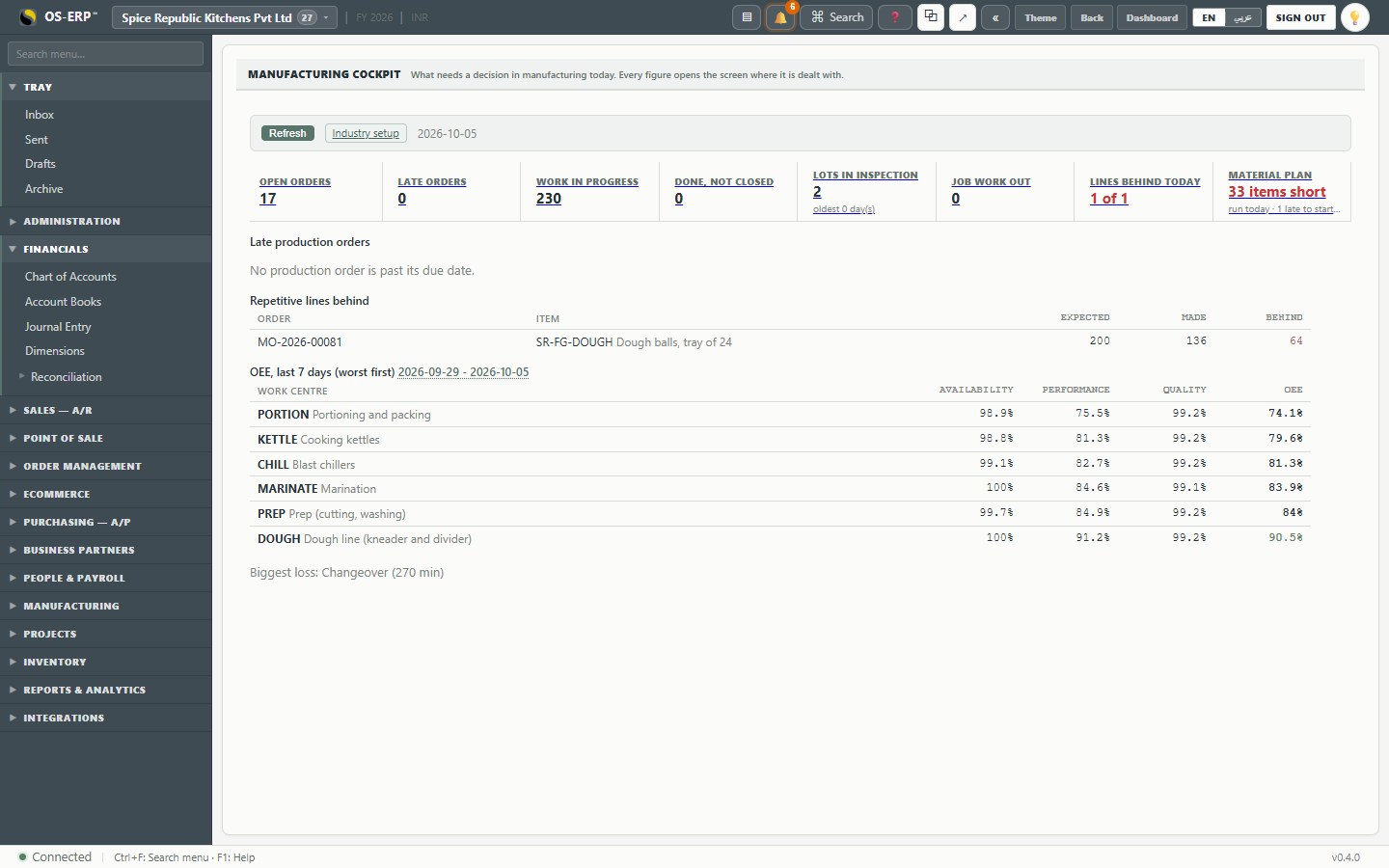
How to read this case study
Each chapter is one part of the kitchen's week, in the order it happens. Each shows the screens in the order the team used them, explains every field, and ends with what it meant for the kitchen. Read it in order the first time; then use it as a reference when you set up your own production.
Chapters
- The business and setting up manufacturing - the company, its 500 people, the Central kitchen industry pack, work centres and their hourly cost, the stores and the 100 outlets, the cockpit.
- Items, recipes and routings - units, lots and use-by dates, recipes four levels deep with yield, scrap and a by-product, routings, and what a pack should cost.
- Planning - day-by-day forecasts, the stores to plan, planned orders, one item's plan, exceptions, station capacity, converting to orders and the scheduling board.
- The night shift - a production order from release to close: reservations, issuing by hand or backflush, time at each station, output into lots, closing and settling the cost.
- Quality - incoming chicken checked at the door and warm crates refused, cooked food held until its temperatures are entered.
- The dough line and OEE - repetitive production at a daily rate, the line board, and OEE per station with where the time went.
- Dispatch to the outlets - a transfer per outlet every morning, lots and their cost on the vans, stock in transit, and what each outlet used.
- A recall drill - from one pouch's lot to the farm's delivery, and to every outlet that still holds it.
- Costs and reports - yield and variance, the Material Cost Status Report and its drill-down, work in progress, consumption and the register.
- Results and lessons - what changed, lessons for your own kitchen, and exercises with answers.