
Appearance
8. Invoicing, collections and revenue
Back to the case study · Previous: 7. Variations
A profitable project can still sink a company if it is not paid on time, or if its accounts show profit in the wrong months. This chapter shows how the villa was invoiced and collected, and how OSERP recognised its revenue month by month as the work progressed, not as the invoices went out.
8.1 Raise invoices from the billing plan (Billing tab)
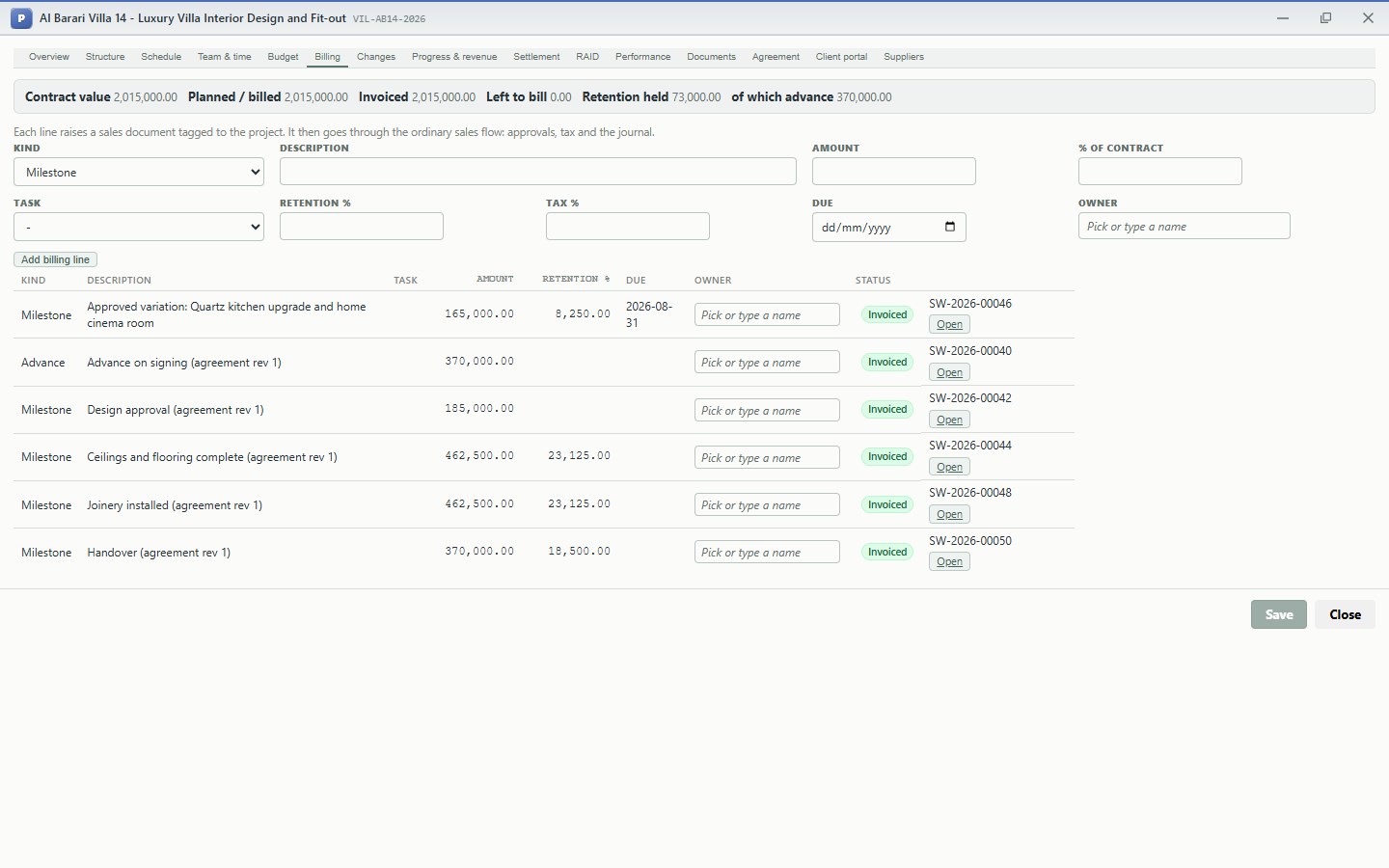
Each billing line has Raise invoice. It creates a client invoice for that instalment through the ordinary sales flow, with 5% VAT, the company's approval rules and the journal, tagged to the project. Mark ready flags a line as due, for example when the client has approved its milestone.
| Invoice | Date | Instalment | Net | VAT | Total | Paid |
|---|---|---|---|---|---|---|
| INV-2026-00022 | 20 Mar | Advance on signing (20%) | 370,000 | 18,500 | 388,500 | 30 Mar |
| INV-2026-00023 | 25 Apr | Design approval (10%) | 185,000 | 9,250 | 194,250 | 10 May |
| INV-2026-00024 | 30 Jun | Ceilings and flooring complete (25%) | 462,500 | 23,125 | 485,625 | 20 Jul |
| INV-2026-00026 | 10 Aug | Joinery installed (25%) | 462,500 | 23,125 | 485,625 | 31 Aug |
| INV-2026-00025 | 15 Aug | Approved variation CO-001 | 165,000 | 8,250 | 173,250 | 31 Aug |
| INV-2026-00027 | 15 Sep | Handover (20%) | 370,000 | 18,500 | 388,500 | 30 Sep |
| Total | 2,015,000 | 100,750 | 2,115,750 |
The summary along the top of the Billing tab reads: Contract value 2,015,000 · Invoiced 2,015,000 · Left to bill 0.00 · Retention held 73,000 · of which advance 370,000. The 73,000 is the 5% the family holds back from the last three milestones and the variation until the twelve-month defects period ends.
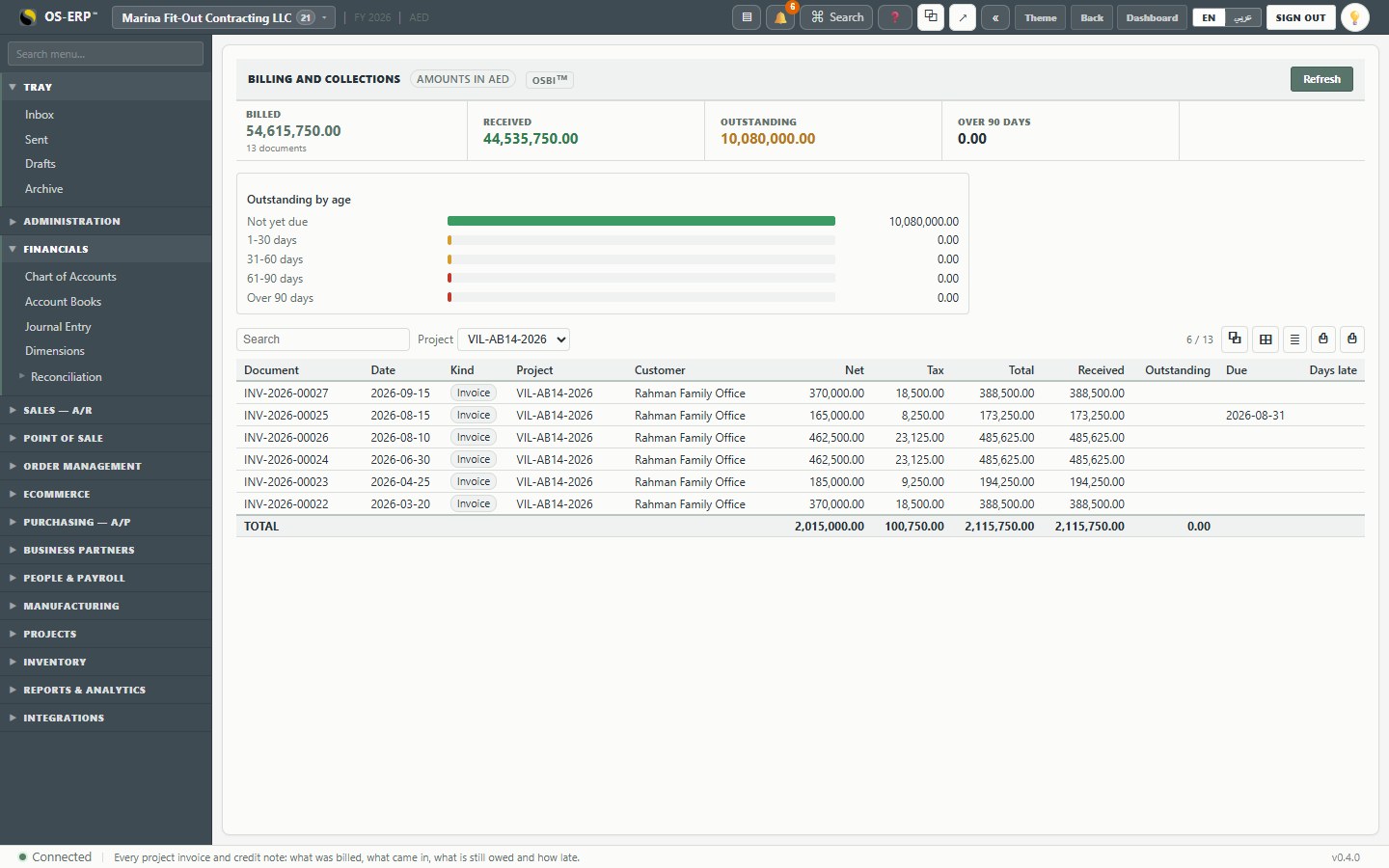
The Billing and collections report (Projects > Reports) shows the same invoices with what was received, what is outstanding and how late:
Cash ahead of cost
The advance (AED 388,500 with VAT) was in the bank on 30 March. The first subcontractor bill was dated 25 April and paid 30 days later. For the whole first two months, the project ran on the client's money, not the company's. A 20% advance written into the agreement (chapter 3) is what made that possible.
8.2 What the client sees
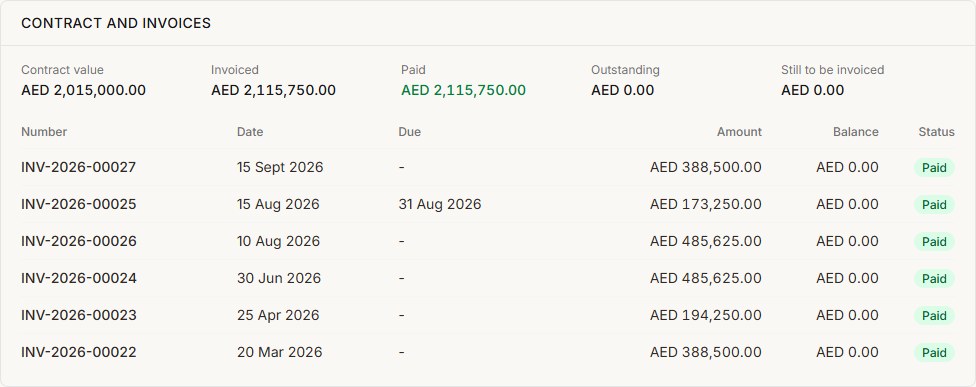
On the family's page, Contract and invoices shows the contract value, what has been invoiced and paid, what is outstanding and what is still to be invoiced, with every invoice and its balance:
Where the company has an online payment gateway set up (see Online payments), each unpaid invoice shows Pay for clients invited with the Pay invoices online right. The payment is recorded against the invoice only after the gateway confirms it.
8.3 Revenue by progress, not by invoice (Progress & revenue tab)
Invoices follow the payment schedule, which is weighted to the start (a 20% advance) and the end (handover). Profit does not work that way. Under IFRS 15, revenue on a contract like this is recognised as the work progresses. Otherwise March looks hugely profitable (an advance and no cost) and the summer looks like a loss.
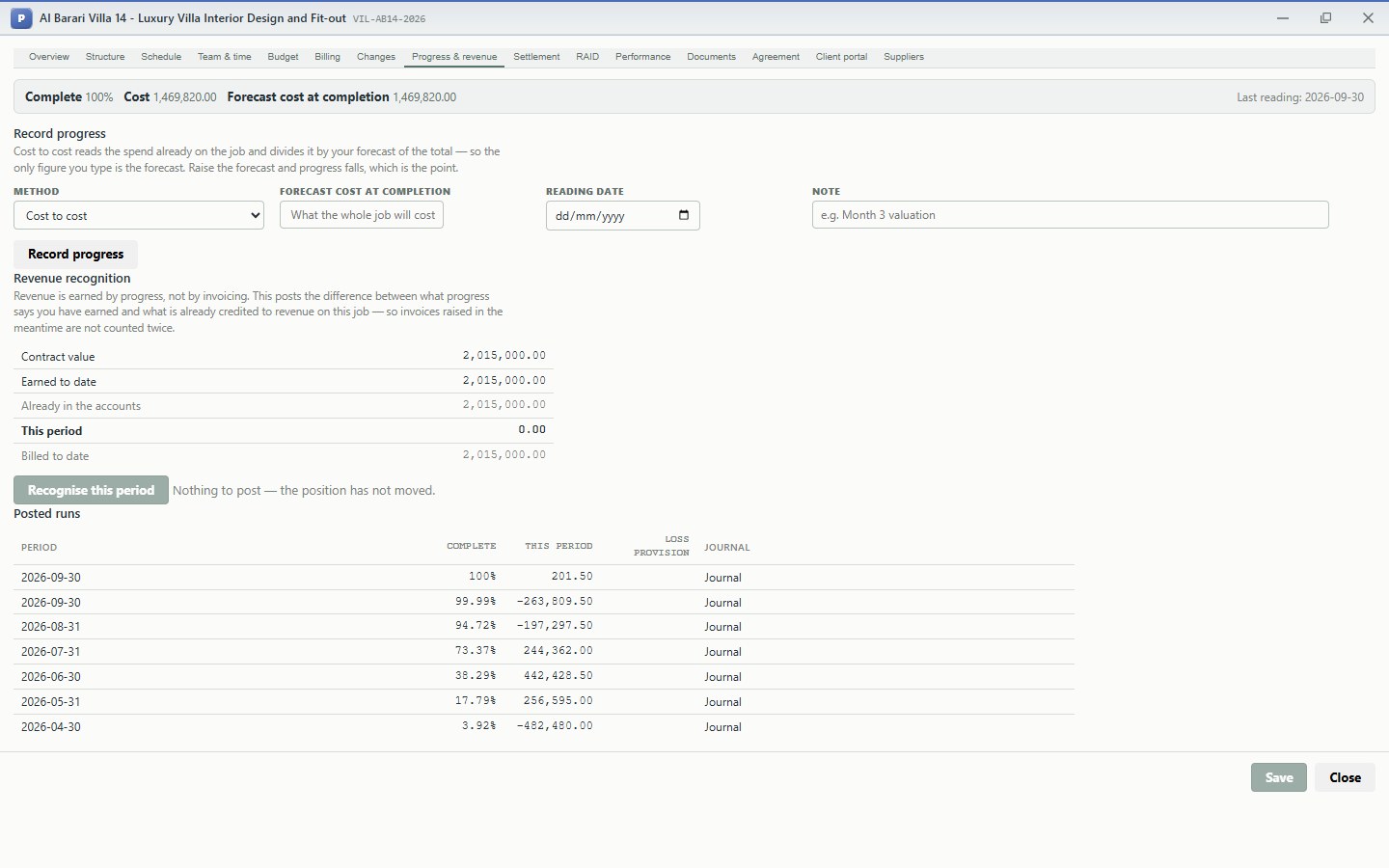
At each month end Priya recorded a progress reading:
- Method: Cost to cost. OSERP reads the cost already posted to the project and divides it by the forecast cost at completion. The only figure she typed was the forecast. If the forecast goes up, progress goes down, which is the point.
- Reading date: the month end.
Then Recognise this period posts the difference between what progress says has been earned and what is already in the accounts.
The whole year, from the Revenue recognition report:
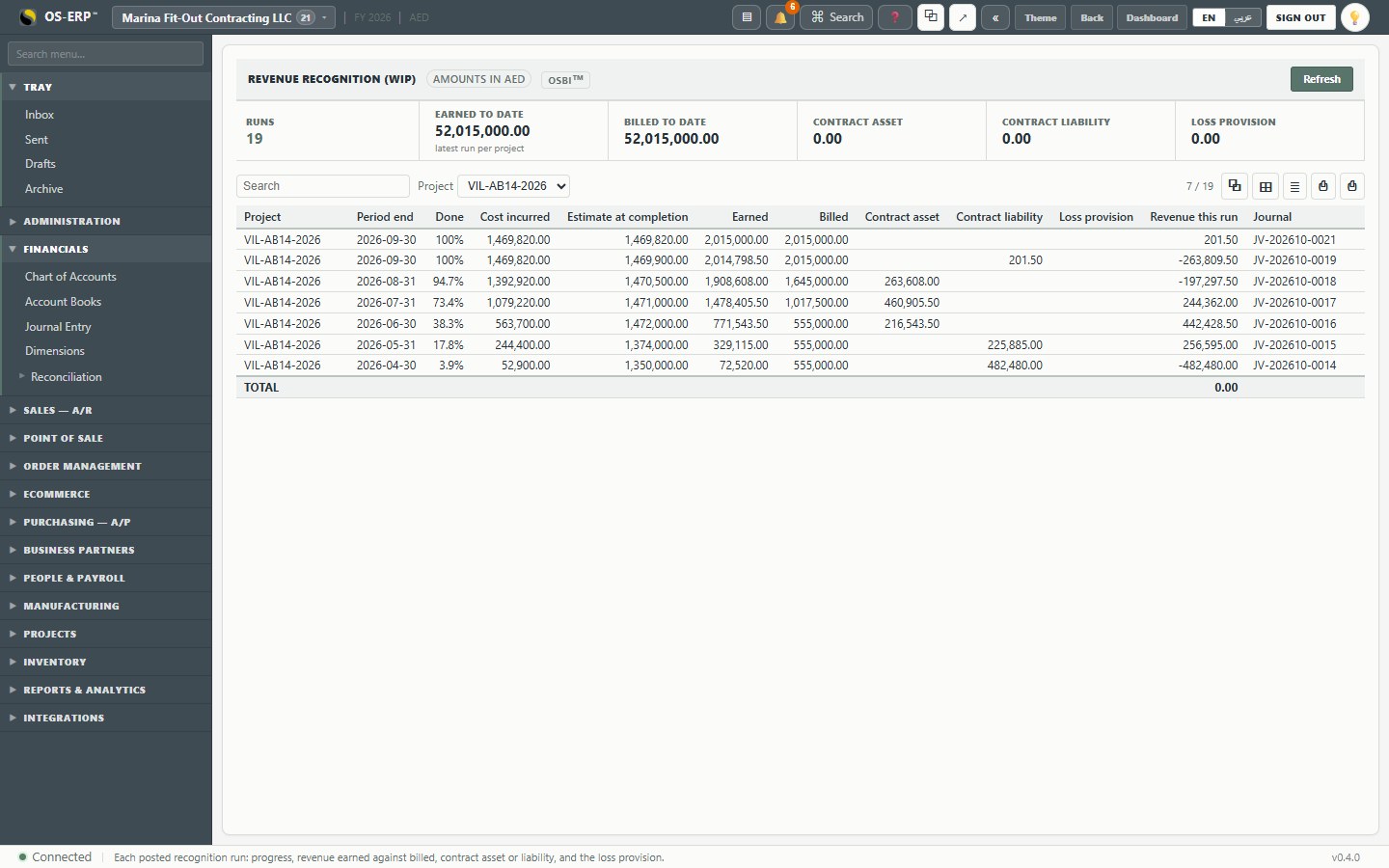
| Month end | Done | Cost incurred | Forecast cost | Earned | Billed | Position |
|---|---|---|---|---|---|---|
| 30 Apr | 3.9% | 52,900 | 1,350,000 | 72,520 | 555,000 | Contract liability 482,480 (billed ahead) |
| 31 May | 17.8% | 244,400 | 1,374,000 | 329,115 | 555,000 | Contract liability 225,885 |
| 30 Jun | 38.3% | 563,700 | 1,472,000 | 771,543.50 | 555,000 | Contract asset 216,543.50 (earned, not yet billed) |
| 31 Jul | 73.4% | 1,079,220 | 1,471,000 | 1,478,405.50 | 1,017,500 | Contract asset 460,905.50 |
| 31 Aug | 94.7% | 1,392,920 | 1,470,500 | 1,908,608 | 1,645,000 | Contract asset 263,608 |
| 30 Sep | 100% | 1,469,820 | 1,469,820 | 2,015,000 | 2,015,000 | Settled |
How to read it:
- Contract liability (April, May): the family had paid more than the work done. The advance is not profit yet. It is a debt of work owed to the client, and sits on the balance sheet.
- Contract asset (June to August): more work done than invoiced. It is revenue earned and not yet billed, also on the balance sheet.
- The forecast changed in June, from 1,374,000 to 1,472,000, when the variation's cost was added. Progress recalculated against the new forecast, and the variation's price was in the contract value, so the margin stayed right in every month.
- Loss provision: if the forecast cost ever exceeds the contract value, OSERP books the whole expected loss at once, as the standard requires. This project never needed one.
Why this matters to the owner
With monthly recognition, the company's management accounts show the villa's real margin every month: about 27% throughout. Without it, the March accounts show a large profit (the advance), the summer months show losses (the subcontractor bills), and nobody can tell whether the job is healthy until it closes.
8.4 Earned value (Performance tab)
The Performance tab measures the job against its baseline using earned value:
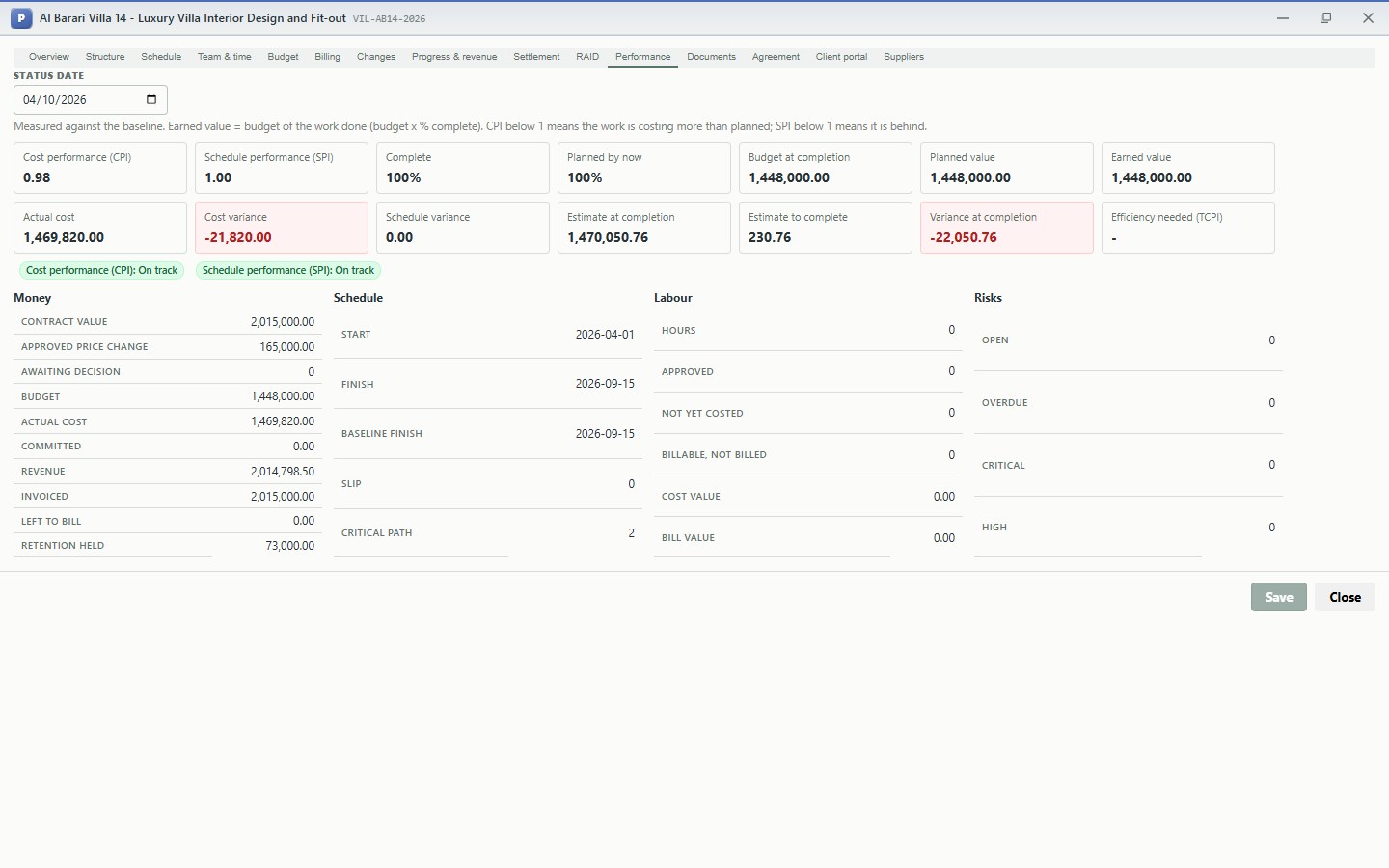
| Measure | Value | Meaning |
|---|---|---|
| Cost performance (CPI) | 0.98 | For every dirham of budget earned, the job spent 1.02. Below 1 means over budget. |
| Schedule performance (SPI) | 1.00 | On programme. |
| Cost variance | -21,820 | The original subcontract overrun from chapter 4. |
| Budget at completion | 1,448,000 | The tender budget plus the variation's 98,000 supplement. |
The Money, Schedule, Labour and Risks panels below summarise the contract, the approved changes, retention held, the programme, booked time and open risks, on one screen.
Note what the CPI does not say. The job was 1.5% over its cost budget, yet its profit was above plan, because the variation earned more than the overrun cost. CPI measures cost discipline; the Overview's Margin measures the money. A good project manager reads both.
What this chapter means for the business
- Every instalment the client agreed to was invoiced and paid, AED 2,115,750 with VAT, with retention tracked to the end of the defects period.
- The client funded the start of the job through the advance.
- The accounts showed the true margin every month, with no false profit in March and no false losses in the summer.